
RFID Smart Shelf Management: How It Works

RFID Smart Shelf Management: How It Works
1. Why Retailers Use RFID for Smart Shelf Management
Retailers need to know whether products are actually available on shelves, not just whether inventory records show stock.
Manual counting and barcode scanning require staff to check products individually. Between checks, shelves may become empty while stock remains in the backroom. Products placed in the wrong location can also go unnoticed.
RFID smart shelf management helps address these challenges by identifying tagged products within defined reading zones. When connected to inventory software, the system can support more frequent stock checks, identify potential shortages, and help staff prioritize replenishment.
2. How RFID Smart Shelf Management Works
Tag products: Each product receives an RFID tag linked to its SKU or inventory record.
Read product tags: An antenna transmits RF energy and receives responses from compatible tags within its effective reading area.
Collect tag data: The RFID reader sends detected tag IDs to the application.
Update inventory information: Software filters repeated reads and associates detected tags with the correct shelf zone.
Trigger action: When observed shelf stock falls below a configured threshold, the system can alert staff to check and replenish the shelf.
The antenna determines an important part of the reading area, while the reader collects tag data and the software turns that data into inventory information.
For example, if a shelf’s observed inventory falls below its replenishment threshold, the system can prompt staff to check the shelf and backroom. RFID provides the identification data; inventory rules and, where available, POS data help determine what action is appropriate.
3. How to Deploy RFID on Retail Shelves
Step 1: Define the reading zones
Determine whether the system needs to monitor an entire shelf, individual compartments, or separate product sections. Record shelf dimensions, installation space, product packaging, and tag positions.
Clearly defined zones help the software associate detected products with the correct shelf.
Step 2: Select and install the antennas
The antenna should match the required reading area and shelf structure.
- Near-field RFID antennas
These are candidates for applications that require controlled, localized identification. They may be considered when the design needs to limit reading to a particular surface or compartment.
For example, Airplux offers the APRIA9006030NF, a circularly polarized near-field antenna for 902–928 MHz with dimensions of 600 × 300 mm. Its physical size makes it a candidate for evaluating coverage across a corresponding shelf area, but the actual reading boundary must be measured in the installed configuration.

- Narrow-beam RFID antennas
These can be considered when the installation needs a more directionally controlled reading area. Their suitability depends on the shelf geometry, antenna orientation, distance to the tags, and the separation required between adjacent zones.
One example is Airplux’s APRIA9008CN, specified for 902–928 MHz, with 8 dBi gain, circular polarization, and dimensions of 300 × 135 × 16 mm.

Step 3: Configure the reader and inventory software
Connect the antennas to a compatible RFID reader and map each reader port to its shelf location. Configure the reading schedule and reader settings for the intended application.
The software should link tag IDs to product records, filter repeated observations, and compare detected tags with expected inventory. If the retailer also integrates POS and backroom inventory data, it can better distinguish sales, shelf shortages, and products that may need to be relocated or replenished.
Step 4: Test the complete system
Test representative products in their actual packaging and shelf positions. Confirm that the intended tags are detected, neighboring shelves are not incorrectly counted, and inventory alerts follow the configured rules.
Use the results to adjust antenna placement, reader settings, or software logic before expanding the installation.
4. Choosing the Right Frequency Band
Airplux offers RFID antenna ranges for both ETSI 865–868 MHz and FCC 902–928 MHz applications.
The correct version depends on the deployment market’s RF regulations and compatibility with the reader and tags.
5. How to Test and Validate an RFID Smart Shelf Installation
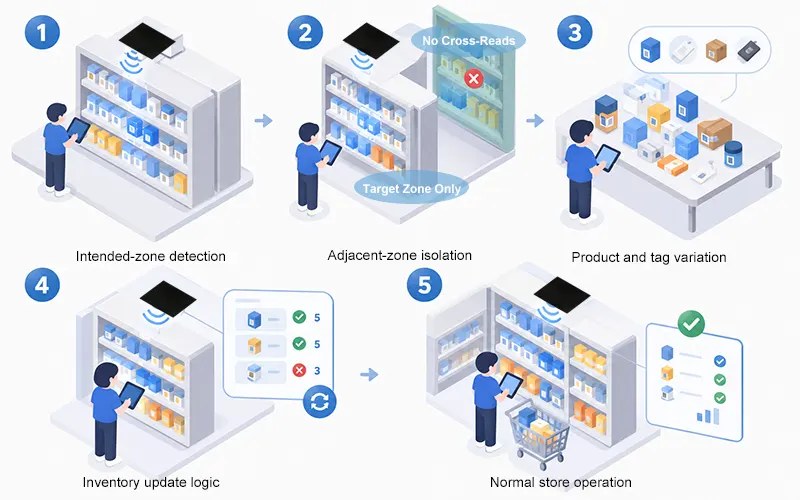
Before rolling out the system across an entire store, test it with representative products and the actual shelf construction.
Test 1: Intended-zone detection
Place tagged products in different positions across the target shelf. Check whether the reader detects them consistently under normal operating conditions.
Test 2: Adjacent-zone isolation
Place tagged products on neighboring shelves or in nearby compartments. Check whether their reads are incorrectly attributed to the target zone.
Test 3: Product and tag variation
Test different packaging materials, tag positions, tag orientations, and product arrangements. Include the products most likely to present RF challenges.
Test 4: Inventory update logic
Verify that repeated reads do not inflate the count, that changes in tag detection are processed correctly, and that the software applies the intended replenishment rules.
Test 5: Normal store operation
Repeat the tests with realistic shelf loading and product handling. Recheck performance after making changes to antenna position, reader settings, or shelf construction.
Record the test conditions and results. Useful measures include the proportion of expected tags detected, unwanted reads from neighboring zones, the time required for inventory updates, and the consistency of the resulting stock records.
These are proposed validation measures, not guaranteed performance figures for any particular antenna. Acceptance thresholds should be set according to the retailer’s requirements and confirmed through testing.
Conclusion
RFID smart shelf management helps retailers collect product-level data more frequently and use it to support shelf inventory checks, replenishment, and location-discrepancy investigations.
Successful deployment depends on defining the reading zones, choosing suitable antennas, configuring the reader, and integrating tag data with inventory software. Airplux’s near-field and narrow-beam RFID antenna ranges provide options to evaluate for different shelf layouts and reading requirements.
Looking for an RFID antenna for your retail application? Contact Airplux with your frequency band, shelf dimensions, and required reading area to discuss suitable options.
Contact
We are always ready to serve you.
Please feel free to contact us
for any antenna inquiry or requirement.
Leave us a message in the form below and
we will get back to you within 24 hours.