
Ultra Slim UHF RFID Antenna
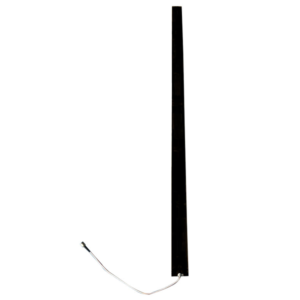
Ultra Slim UHF RFID Antenna
Model: APRIA9007LX
Frequency Range: 902-928MHz
Polarization: Linear
Gain: 7dBi
Descriptions
- 902-928MHz
- 7dBi
- Linear Polarization
- 820*35*5mm
Applications
- Production line management
- Garment management
- Door control system
- Intelligent inventory management
Electrical Specifications | |
Frequency | 902-928MHz |
Gain | 7dBi |
Beam width | Hor:20° Ver:210° |
Polarization | Linear |
VSWR | ≤1.5 |
F/B Ratio | ≥20 |
Impedance | 50Ω |
Maximum power | 50W |
Lightning protection | DC Ground |
Connector | SMA-Female |
Mechanical Specifications | |
Dimension | 820*35*5mm |
Net weight | 0.28kg |
Packing size | 84*5*3cm |
Gross weight | 0.5kg |
Operating temperature | -40-70℃ |
PRODUCT SUPPORT
FAQ - 902–928MHz UHF RFID Antenna
Choosing the right 902–928MHz RFID antenna involves more than checking its frequency range. Consider the following factors:
- Gain: Determines how RF energy is distributed in the antenna’s radiation pattern.
- Beamwidth: Helps define the intended horizontal and vertical coverage.
- Polarization: Circular polarization can accommodate variations in tag orientation, while linear polarization can work well when tag alignment is predictable.
- Installation: Consider the available mounting space, antenna orientation, and surrounding materials.
- Compatibility: Check the reader’s frequency range, impedance, connector interface, and supported RF power.
The best antenna depends on the reading area, tag placement, and operating requirements of the application.
The 902–928MHz band is shared by different types of wireless devices, so interference may occur when multiple systems operate nearby. In RFID installations, nearby readers and other RF sources may affect reading consistency, particularly in environments with several wireless systems.
Interference management usually involves suitable reader configuration, frequency planning, transmit power control, and frequency-hopping techniques where supported by the system. Antenna selection also matters: an appropriate radiation pattern and polarization can help control the intended reading area. Proper impedance matching supports efficient power transfer, but it does not eliminate interference from other devices.
Ultra-slim RFID antennas can be integrated into production equipment and workstations to identify tagged products as they move through different manufacturing stages. They help capture product information at designated checkpoints, supporting work-in-progress tracking, process monitoring, and production records. A long, narrow antenna design can be useful when installation space is limited along a conveyor or production fixture. Its placement should be matched to product movement and tag position to support consistent identification.
Yes. UHF RFID antennas are commonly used in garment management systems to identify tagged clothing during sorting, stocktaking, and distribution. They can be installed at designated reading points to capture garment information as items pass through a workflow. For reliable identification, consider how garments move, where tags are attached, and how closely items are grouped. Antenna positioning and reader settings should be tested with the actual garments and tags.
Linear and circular polarization describe how an RFID antenna’s electric field is oriented. A linearly polarized antenna has a fixed polarization direction, so its orientation should be matched as closely as practical with the tag antenna. Circular polarization can offer greater flexibility when tag orientation varies. The appropriate choice depends on how tagged items are positioned and presented during reading. With linear polarization, inconsistent tag orientation may reduce reading performance.
RFID antennas support intelligent inventory management by identifying tagged items at selected storage, handling, and stocktaking points. When connected to an RFID reader and inventory software, the system can collect tag information and update inventory records, helping businesses monitor item movement and availability. The antenna arrangement should be planned according to storage layout, tag placement, and the intended reading zones. System testing is important to reduce missed reads and unintended identification.
Please feel free to contact us by info@airpluxtec.com for more detailed info if you’re interested in this Antenna, or please check here for our more Ultra Slim UHF RFID Antenna products.
Contact
We are always ready to serve you.
Please feel free to contact us
for any antenna inquiry or requirement.
Leave us a message in the form below and
we will get back to you within 24 hours.