
8dBi UHF RFID Reader Antenna with Enclosure
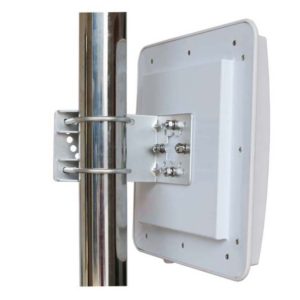
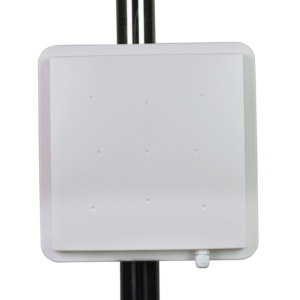
UHF RFID Reader Antenna with Enclosure
Model: APRIA8008CT
Frequency Range: 865-868MHz
Polarization: Circular
Gain: 8dBi
Descriptions
- 865-868MHz
- 8dBi
- Circular Polarization
- 256*256*60mm
Applications
- RFID logistics tracking
- Warehouse management
- Door control system
- Man management system
Electrical Specifications | |
Frequency | 865-868MHz |
Gain | 8dBi |
Beam width | Hor:60° Ver:60° |
Polarization | Circular |
VSWR | ≤1.4 |
F/B Ratio | ≥20 |
Impedance | 50Ω |
Maximum power | 50W |
Lightning protection | DC Ground |
Connector | Customized |
Mechanical Specifications | |
Dimension | 256*256*60mm |
Net weight | 1.0kg |
Packing size | 40.5*30.5*10.5cm |
Gross weight | 1.9kg |
Radome material | ABS |
Radome colour | White |
Pole Diameter | Φ30-50mm |
Rated wind velocity | 60m/s |
Operating temperature | -40-70℃ |
PRODUCT SUPPORT
FAQ - ETSI UHF Integrated RFID Reader Antenna
An integrated RFID reader antenna is a device that combines an RFID reader and an antenna into a single unit. Unlike a traditional RFID setup that uses a separate reader and external antenna, this design reduces the number of individual components and simplifies system installation. It can be used in applications such as access control, inventory management, asset tracking, and automated identification. The exact functions depend on the reader’s communication interfaces, supported protocols, and system configuration.
An integrated UHF RFID reader antenna sends radio-frequency signals to detect nearby RFID tags. When a compatible passive UHF tag receives the signal, it uses the energy from the reader’s transmission to respond with its stored identification data. The integrated reader processes this response and makes the collected information available to the connected system. Reading performance depends on factors such as antenna characteristics, tag design, reader settings, and the surrounding environment.
Circularly polarized RFID antennas can communicate with tags whose orientations vary within the reading area. Unlike linear polarization, circular polarization is generally less sensitive to the rotational alignment of a tag antenna. This makes it useful in applications where items move or tags cannot always be positioned in a consistent direction. However, tag orientation, distance, surrounding materials, and antenna placement still affect reading performance.
RFID antennas should be positioned according to the direction of movement, tag location, and intended identification area. Consider the mounting height, antenna angle, entrance width, and distance between the antenna and tagged credentials. The goal is to detect authorized tags within the designated area while limiting reads from nearby spaces. Testing with people carrying tags in realistic positions is important before the system goes live.
Yes. Multiple RFID antennas can be deployed to cover different sections of a warehouse, entrance, or personnel identification area. Each antenna should be positioned according to the required coverage and connected to a compatible reader system. Antenna spacing, reader configuration, and RF interference should be evaluated to reduce overlapping reading zones and unintended tag detection.
Personnel tracking performance depends on several factors, including tag placement, antenna polarization, reader output power, antenna position, and the surrounding environment. The human body can also absorb or affect RF signals, particularly when RFID tags are worn close to the body. Choosing suitable badge or tag designs and testing their placement in real operating conditions can help improve identification consistency.
Please feel free to contact us by info@airpluxtec.com for more detailed info if you’re interested in this Antenna, or please check here for our more UHF RFID Reader Antenna with Enclosure products.
Contact
We are always ready to serve you.
Please feel free to contact us
for any antenna inquiry or requirement.
Leave us a message in the form below and
we will get back to you within 24 hours.