
5G vs 6G: What’s the Difference and What Comes Next?

introduction:Why Is the Industry Already Talking About 6G?
If you follow wireless news, you’ve probably noticed something odd: 5G networks are still rolling out in many countries, yet researchers and companies are already talking about 6G. At first glance, that may seem premature.
Not really. Mobile communication has always moved in roughly ten-year cycles. The first major 5G standards were finalized in 2018, and the vision for IMT-2030—now known as 6G—began taking shape shortly afterward. If the pattern holds, commercial 6G networks could begin appearing around 2030.
What’s important to understand is that 5G vs 6G is not simply a race for faster speeds. While 5G continues to evolve through 5G-Advanced, 6G research is exploring new possibilities such as AI-native networking, sub-terahertz communication, and integrated sensing.
Rather than replacing 5G overnight, 6G is expected to build on the foundation being created today. In this article, we’ll explore the key differences between 5G and 6G, the technologies behind them, and what these changes could mean for future wireless infrastructure.
Key Takeaways
• 5G deployment is still expanding worldwide, but 6G research is already underway.
• 6G is expected to introduce AI-native networking, sub-terahertz communication, and integrated sensing capabilities.
• Rather than replacing 5G, 6G will likely evolve alongside existing networks.
• Future wireless applications may require new antenna technologies and network architectures.
5G and 6G at a Glance
| Feature | 5G | 6G |
|---|---|---|
| Status | Commercially Deployed | Research & Standardization |
| Peak Data Rate | Up to 20 Gbps | Up to 1 Tbps (Target) |
| Latency | Around 1 ms | Below 0.1 ms (Target) |
| Spectrum | Sub-6 GHz, mmWave | mmWave, Sub-THz |
| Network Intelligence | AI-Assisted | AI-Native |
| Coverage | Terrestrial Networks | Integrated Ground, Air & Space |
| Key Technologies | Massive MIMO, Beamforming | AI-Native Networks, Integrated Sensing |
| Typical Applications | Smart Manufacturing, IoT, Mobile Broadband | Digital Twins, XR, Autonomous Systems |
what is 5G?
5G is the wireless generation most of us are using today. It was built to solve a practical problem: more devices, more data, and less tolerance for delay. To do that, 5G introduced three core capabilities—faster mobile broadband, ultra-reliable low-latency connections, and massive-scale IoT support. In industry language, those are eMBB, URLLC, and mMTC.
Under the hood, 5G uses a mix of spectrum. Sub-6 GHz bands provide wide-area coverage, while millimeter-wave frequencies step in where capacity matters most. On top of that, technologies like Massive MIMO and beamforming squeeze more performance out of every antenna. The result is a network that feels noticeably faster and more responsive than 4G—but it’s still just the starting point.

what is 6G?
If 5G was about connecting more things, 6G is about making the network think. It’s the next generation of wireless communication, still in the research and early standardization phase. The ITU has already laid out a high-level vision through its IMT-2030 framework, and it goes well beyond raw speed.
6G researchers are working on sub-terahertz frequencies, AI-native network architectures, and satellite-assisted coverage. The goal is to support applications that need extreme capacity and near real-time responsiveness—things like holographic communication, digital twins, and networks that can sense their environment. Commercial deployment won’t happen before 2030, but the direction is already clear: 6G aims to blur the line between communication and computation.
5G vs 6G: Key Technology Differences
two shifts define the leap from 5G to 6G. The first happens in the physical layer—a move from millimeter-wave spectrum toward terahertz frequencies. The second happens in the network itself—a transition from edge computing to AI-native intelligence. Together, they explain why 6G isn’t just a faster version of 5G, but a fundamentally different kind of network.
mmWave vs Terahertz Communication
5G’s spectrum strategy balances coverage and capacity. Sub-6 GHz bands provide reliable wide-area coverage, while millimeter-wave frequencies (24–100 GHz) deliver high bandwidth in dense environments. The trade-off is well known: mmWave signals don’t travel far and struggle with obstacles.
6G pushes into new territory. Researchers are targeting extended mmWave bands (100–300 GHz) and sub-terahertz frequencies up to 3 THz and beyond. These bands offer dramatically wider channels and the potential for terabit-per-second speeds. But the physics gets harder—signals attenuate faster, and atmospheric absorption becomes a real concern.
For antenna engineers, this isn’t a simple frequency upgrade. Terahertz systems demand extremely directional beams, denser arrays, and new approaches to thermal management and packaging. The antenna architectures that worked for 5G mmWave won’t scale up without fundamental redesign.

Edge Computing vs AI-Native Computing
5G reduced latency by bringing computing closer to users through edge infrastructure. Instead of sending all data to centralized clouds, edge nodes near base stations can process information locally, supporting applications such as industrial automation, machine vision, and connected vehicles.
6G is expected to take this concept further through AI-native networking. Rather than treating AI as an additional layer, intelligence becomes part of the network itself. Networks can learn from traffic patterns, predict demand, allocate resources dynamically, and optimize performance in real time.
For operators, this marks a shift from automation to autonomy. Future networks may not only react to changing conditions but also anticipate them. At the same time, antennas, radios, and network software will become more tightly integrated, working together as a continuously adaptive system.
The result is a network that not only moves data efficiently, but also helps determine how resources should be used and where capacity is needed most.

Future Applications Driving Antenna Demand
Technology differences matter, but applications drive hardware requirements. The shift from 5G to 6G is often described as a move from faster connectivity to a deeper integration of communication, sensing, computing, and AI—and that shift becomes most visible in the applications future networks are expected to support.
Digital Twins
Digital twins are virtual representations of physical systems that update continuously using real-world data. Future factories, transportation networks, and smart cities may rely on digital twins to monitor operations, simulate scenarios, and optimize performance in real time.
Supporting these environments requires reliable connectivity, low latency, and the ability to process large volumes of data. This creates greater demand for antenna systems capable of delivering stable coverage and consistent capacity across complex deployments.
Non-Terrestrial Networks (NTN)
Future wireless coverage is expected to extend beyond traditional terrestrial infrastructure. Satellites, high-altitude platforms, and low-altitude drones may work together with ground networks to create more seamless connectivity across wider areas.
These scenarios introduce new antenna challenges, including wide scan angles, multi-beam operation, and accurate beam tracking. At the same time, systems must meet strict size, weight, and power requirements, particularly for airborne and space-based platforms.
Integrated Sensing and Communication (ISAC)
One of the most distinctive goals of 6G is the integration of sensing and communication within the same wireless system. Future networks may not only transmit data but also detect movement, monitor environments, and provide highly accurate positioning services.
For antenna designers, this means communication and sensing functions may increasingly share the same hardware platform. Antenna arrays will need to support both connectivity and environmental awareness while maintaining high efficiency and performance.
Immersive XR and Holographic Communication
Future XR experiences are expected to go far beyond today's AR and VR applications. Researchers are also exploring holographic communication, where users interact with highly detailed, real-time digital representations instead of traditional video streams.
These applications demand extremely high throughput, ultra-low latency, and reliable wireless links. Supporting them will depend on advanced antenna arrays that provide wider bandwidth, higher gain, and more precise beamforming than current networks can deliver.
The common thread across these applications is clear: antennas are evolving from passive RF components into active, adaptive elements of the wireless ecosystem. As future services continue to push the boundaries of coverage, capacity, sensing, and intelligence, antenna technology will remain a critical enabler of next-generation connectivity.
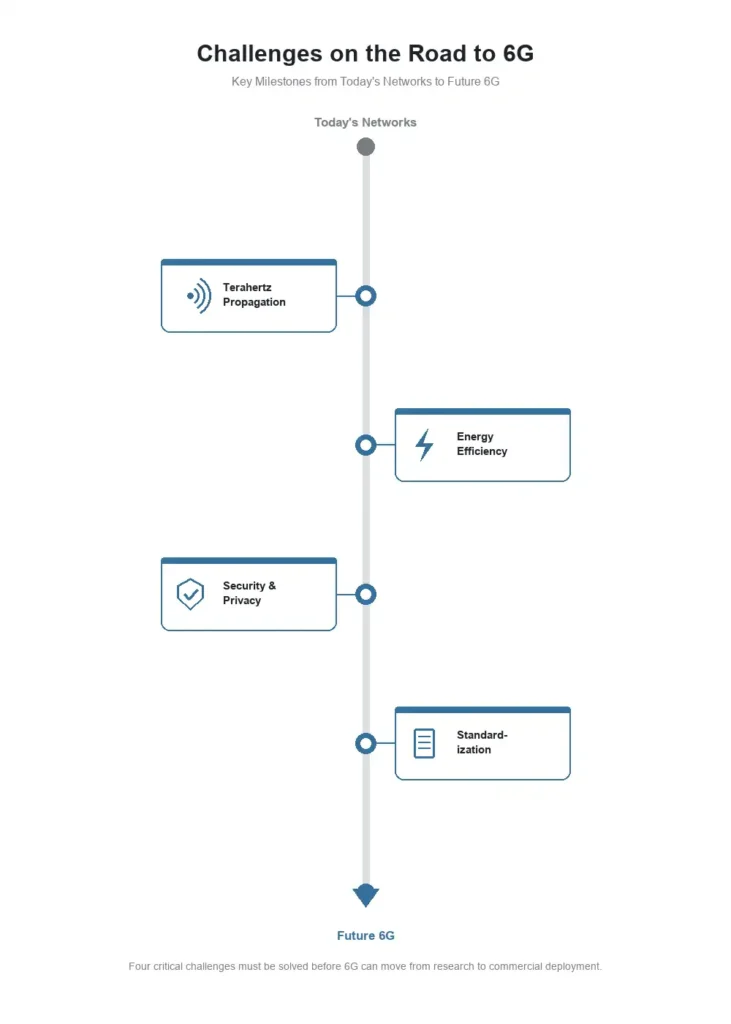
Challenges on the Road to 6G
The vision for 6G is ambitious, but turning that vision into commercial reality will take time. Several technical and practical challenges still stand between today’s research and tomorrow’s networks.
Terahertz Physics and Hardware
Sub-terahertz and terahertz frequencies offer enormous bandwidth, but they also introduce higher propagation loss, stronger signal attenuation, and greater sensitivity to obstacles. RF components, antenna arrays, packaging, and thermal management systems must all evolve to operate efficiently at these frequencies—an engineering challenge that goes well beyond simply scaling up 5G hardware.
Cost and Energy Efficiency
Future 6G networks are expected to support AI-native services, integrated sensing, and massive device connectivity. These capabilities expand what networks can do, but they also increase demands on infrastructure, spectrum, and energy. Some studies estimate that 6G deployment could cost 200% to 840% more than 5G, while AI workloads and sensing functions will push power consumption significantly higher. Improving efficiency will be just as important as improving performance.
Security and Privacy
AI-native networking and integrated sensing create new opportunities, but they also introduce new risks. AI-native networks open attack surfaces such as model poisoning, while integrated sensing raises concerns about unauthorized monitoring and data confidentiality. Future networks must protect not only transmitted data, but also information derived from sensing, positioning, and intelligent network operations.
Standardization and Ecosystem Alignment
Many of the technologies associated with 6G are still being studied and standardized. First specifications are expected around 2029, and successful deployment will depend on global cooperation among operators, equipment vendors, regulators, and standards organizations to ensure interoperability and avoid unnecessary complexity.
None of these challenges are insurmountable, but they explain why 6G won’t arrive overnight—and why antenna and RF innovation remains central to making it real.
Will 6G Replace 5G?
Not really. 6G won’t wipe out 5G—it will build on top of it. Mobile generations tend to overlap, and this one will be no different.
Part of the reason is that 5G is still evolving. Through 5G-Advanced, the industry continues to improve network intelligence, MIMO performance, satellite connectivity, and support for emerging applications such as XR and industrial IoT. Much of that work is already feeding into 6G research.
There’s also a practical side. Operators have invested heavily in spectrum, towers, and devices. Replacing all of that overnight isn’t realistic. The more likely path is resource sharing—5G and 6G running side by side during the transition.
Timing points the same way. 6G standards are still being studied, and commercial launches aren’t expected until the early 2030s. Even then, adoption will be gradual. 5G will remain the workhorse for years.
So 6G is better seen as the next layer of wireless capability, not a replacement. 5G keeps handling mainstream connectivity. 6G goes after applications that need more intelligence, sensing, and autonomy.

Final Thoughts
5G to 6G is not just about speed. It’s a broader shift in how networks use spectrum, embed intelligence, and support new applications. While 5G continues to evolve through 5G-Advanced, 6G research is already exploring areas such as terahertz communication, AI-native networking, integrated sensing, and non-terrestrial connectivity.
For antenna and RF engineers, the impact is already becoming clear. Higher frequencies, wider bandwidths, and more dynamic architectures are reshaping antenna design requirements. Advanced beamforming, intelligent arrays, and adaptive RF systems are becoming increasingly important as wireless networks continue to evolve.
Whether 6G arrives in the early 2030s or later, the direction is clear. The real question is how well the industry prepares for the transition.
At Airplux, we’re working on the antenna and RF technologies that will help bridge today’s networks and tomorrow’s.