
5G NR Frequency Bands : From Low Band Coverage to mmWave Capacity

Introduction
If you’ve ever looked at a 5G device specification or a mobile operator’s coverage map, you’ve probably come across terms such as n28, n41, n77, or n78. These numbers refer to 5G NR bands — specific frequency ranges used to deliver different types of 5G services.
However, not all 5G bands are designed for the same purpose. Some prioritize wide-area coverage, while others focus on capacity, speed, or support for dense urban environments. As 5G deployments continue to expand worldwide, understanding how these bands work has become increasingly important for network planners, system integrators, and businesses deploying wireless infrastructure.
In this guide, we’ll explore how the 5G spectrum is organized, the differences between Low Band, Mid Band, and mmWave frequencies, and why bands such as n28, n41, n77, n78, and n79 play a critical role in modern 5G networks. We’ll also look at the antenna considerations associated with different frequency ranges and deployment scenarios.
I. Understanding 5G NR Bands and Spectrum
5G networks rely on radio spectrum to transmit data between devices and base stations. Instead of operating on a single frequency, 5G New Radio (NR) uses a wide range of spectrum bands to support different deployment requirements.
· What Is 5G Spectrum?
5G spectrum refers to the specific radio frequencies that 5G networks use to carry data. Spectrum is measured in hertz (Hz), and different frequency ranges behave differently. Lower frequencies travel farther and pass through walls more easily, while higher frequencies carry more data but cover shorter distances. 5G uses a much wider range of spectrum than earlier mobile generations, from below 1 GHz up to millimeter wave frequencies above 24 GHz.
· What Are 5G NR Bands?
5G NR bands are the standardized frequency bands defined by 3GPP for 5G New Radio. Each band has a unique identifier starting with the letter “n”, such as n1, n78, or n257. These identifiers let network operators, device makers, and regulators refer to the same frequency range consistently. A single 5G network may use several NR bands at the same time to balance coverage, capacity, and performance.
- Each 5G NR band occupies a specific frequency range and offers unique performance characteristics. Lower frequencies generally provide broader coverage and better building penetration, while higher frequencies are designed to deliver greater capacity and faster data speeds.To simplify these differences, 5G spectrum is often divided into three broad layers: low band, mid band, and mmWave.
< 1 GHz
Low Band
wide performance
strong penetration
lower speeds
1-6 GHz
mid Band
balanced performance
good speed & coverage
mainstream 5G bands
24 GHz+
mmWave
large capacity
very high speed
short range
· 5G NR Band Categories Overview
Although 3GPP has defined more than one hundred NR bands, only a limited number are widely used in commercial 5G deployments. The overview below shows how commonly deployed bands are grouped across different spectrum categories.

- While all 5G NR bands are part of the same 5G standard, each category plays a different role in delivering coverage, capacity, and user experience.
Ⅱ. Low Band vs Mid Band vs mmWave
Although all 5G networks use the same NR technology, not all spectrum bands deliver the same user experience. To balance coverage, capacity, and deployment cost, 5G spectrum is generally divided into three categories: Low Band, Mid Band, and mmWave.
Each category serves a different role within the network. Low Band focuses on broad coverage, Mid Band provides the best balance between coverage and performance, while mmWave is designed for ultra-high capacity in dense environments.
coverage
speed
indoor penetration
Latency
Typical Use
low band
★★★★★
★★
★★★★★
~30–50 ms
Rural Areas
min band
★★★★
★★★★
★★★
~15–30 ms
Urban Networks
mmWave
★
★★★★★
★
~5–15 ms
Stadiums & Hotspots
Ⅲ. FR1 vs FR2: Understanding 5G Frequency Ranges
While 5G spectrum is commonly described as Low Band, Mid Band, and mmWave, 3GPP uses a more formal classification system based on frequency ranges: FR1 and FR2. Understanding these two ranges helps explain why some 5G bands prioritize wide-area coverage while others are designed for maximum capacity and speed.
· What Is FR1?
FR1 covers frequencies from 410 MHz up to 7.125 GHz. This range includes low-band and mid-band spectrum, which is why FR1 is often called “sub-6 GHz” even though its upper limit now sits slightly above 6 GHz.
The biggest advantage of FR1 is practicality. Signals in this range travel far enough to cover entire neighborhoods, penetrate buildings reasonably well, and don’t require extremely dense cell placement. That makes FR1 the foundation of most 5G rollouts today.
Most early 5G networks, especially outside of dense city centers, rely almost entirely on FR1.
· What Is FR2?
FR2 covers millimeter wave frequencies from 24.25 GHz to 52.6 GHz. These bands are sometimes called mmWave, and they behave very differently from FR1.
FR2 signals don’t travel far. They’re easily blocked by walls, glass, trees, and even the human body. But FR2 offers huge amounts of spectrum, which means very wide channels and extremely high speeds. A single FR2 carrier can be 400 MHz wide or more, compared with 100 MHz for a typical mid-band FR1 carrier.
This makes FR2 useful in places where demand is concentrated: stadiums, airports, city squares, and fixed wireless access. It’s also used in private networks and industrial setups where extremely low latency and high throughput matter more than wide coverage.

· FR1 vs FR2:Key Differences
Both frequency ranges bring unique strengths to 5G networks, which is why operators often use them together rather than treating them as competing technologies.
FR1 advantages
- Wide coverage and stronger indoor penetration
- Lower deployment costs and fewer base stations required
- Supports large-scale nationwide network rollouts
- Delivers the balance of coverage and capacity needed for everyday 5G services
FR2 advantages
- Access to very large bandwidths, often 400 MHz per channel or more
- Multi-gigabit speeds and extremely high network capacity
- Ideal for stadiums, airports, and other high-density environments
- Supports demanding applications such as fixed wireless access and private 5G networks
In practice, these two ranges work together rather than compete. FR1 provides the foundation for reliable nationwide coverage, while FR2 adds extra capacity in places where demand is concentrated. That combination is what makes 5G more flexible than earlier mobile generations.
· How FR1 and FR2 Relate to Low Band, Mid Band, and mmWave
So far we’ve looked at FR1 and FR2 as defined by 3GPP. But in everyday industry talk, people often use a simpler three-layer model: low band, mid band, and mmWave. These two systems don’t match up perfectly, but the overlap is strong.
Low band and mid band both sit inside FR1. Low band covers the sub-1 GHz frequencies, while mid band runs from about 1 GHz to 6 GHz. The upper part of FR1, from 6 GHz to 7.125 GHz, is sometimes called “upper mid-band” or “high-band FR1.” It’s not mmWave, but it can provide extra capacity in some markets.
FR2, on the other hand, is exactly what most people mean when they say mmWave. It starts at 24.25 GHz and goes up to 52.6 GHz. That’s where you find very wide channels and very high speeds, but also very short range.
So the mapping looks like this:
Low band → always FR1, below 1 GHz
Mid band → almost always FR1, roughly 1–6 GHz
mmWave → always FR2, above 24 GHz
The 6–7.125 GHz slice → still FR1, sometimes treated as a separate capacity layer
This distinction matters because the terms are used differently depending on who’s talking. A network engineer might say “FR2,” while a carrier’s marketing page says “mmWave.” They’re describing the same physical spectrum, just organized in different ways.
Ⅳ. Why n28 Remains Essential for Coverage
When people talk about 5G, speed usually gets the attention. But speed means very little if the signal can’t reach the user. This is where Band n28 plays a crucial role.
Operating in the 700 MHz range, n28 is one of the most widely deployed low-band 5G frequencies worldwide. While it doesn’t offer the highest data rates, its ability to cover large areas and reach indoor users makes it a key foundation of modern 5G networks.
· Wide-Area Coverage with Fewer Sites
One of the biggest advantages of n28 is its propagation performance.
Compared with mid-band spectrum such as n41, n77, and n78, signals in the 700 MHz range travel much farther before another base station is needed. This allows operators to extend 5G coverage across large geographic areas while using fewer sites.
For rural regions, highways, and remote communities, this can significantly reduce deployment costs while improving network availability.

· Better Indoor Connectivity
Coverage is not only about distance. It is also about reaching users inside buildings.
Lower-frequency signals generally penetrate walls, windows, and other obstacles more effectively than higher-frequency spectrum. As a result, n28 can help improve connectivity inside homes, offices, shopping centers, warehouses, and other environments where mid-band signals may weaken.
This makes n28 an important complement to higher-capacity 5G bands
· The Main Limitation
The main limitation of n28 is capacity.
Compared with mid-band spectrum, the amount of bandwidth available in low-band frequencies is relatively limited. As a result, n28 cannot deliver the same peak data rates as bands such as n41, n77, or n78.
For this reason, operators rarely rely on n28 alone. Instead, it is commonly paired with higher-capacity bands, creating a layered network where low-band spectrum provides coverage and mid-band spectrum provides speed.
· Why It Still Matters
Without low-band spectrum like n28, 5G would be fast in city centers but unreliable everywhere else. n28 is not the band that delivers gigabit speeds. It is the band that keeps people connected when they move indoors, travel outside urban areas, or simply need a stable signal.
That is why n28 remains one of the most important coverage bands in commercial 5G deployments today.
Ⅴ. Why n41 Matters
Among mid-band 5G bands, n41 stands out because it sits in a practical sweet spot. It delivers significantly more capacity than low-band spectrum such as n28, while providing broader coverage than mmWave frequencies. This balance makes it one of the most effective bands for large-scale 5G deployments.
Operating in the 2.5 GHz range (2496–2690 MHz), n41 can support much wider channel bandwidths than typical low-band allocations. That additional spectrum allows operators to deliver faster data rates and serve more users simultaneously, making n41 well suited for high-traffic environments.
· The Balance Between Coverage and Capacity
One of the main reasons n41 has been widely adopted is its ability to balance coverage and performance.
Compared with low-band frequencies, it offers higher throughput and greater network capacity. At the same time, it generally provides better propagation characteristics than higher-frequency spectrum, allowing operators to expand 5G performance without requiring extremely dense site deployment.

· A Key Band for Fixed Wireless Access
Beyond mobile connectivity, n41 has also become an important band for Fixed Wireless Access (FWA). By combining practical coverage with relatively large bandwidth, operators can deliver broadband services to homes and businesses without relying on fiber infrastructure.
This makes n41 a popular choice for residential broadband, 5G CPE deployments, and rural connectivity projects.
· Why It Still Matters
The trade-off is coverage. While n41 reaches farther than higher-frequency bands, it cannot match the wide-area reach of low-band spectrum such as n28.
As a result, many operators deploy n41 alongside low-band frequencies. The low-band layer provides broad coverage, while n41 adds the capacity needed to support growing data demand.
This balance between coverage and capacity is one of the main reasons n41 remains an important part of commercial 5G networks today.
Ⅵ. Why n77 and n78 Became Global Standards
If there’s one band that defines mainstream 5G, it’s n78. And its wider sibling, n77, isn’t far behind. Together, they’ve become the closest thing 5G has to a global mid-band standard.
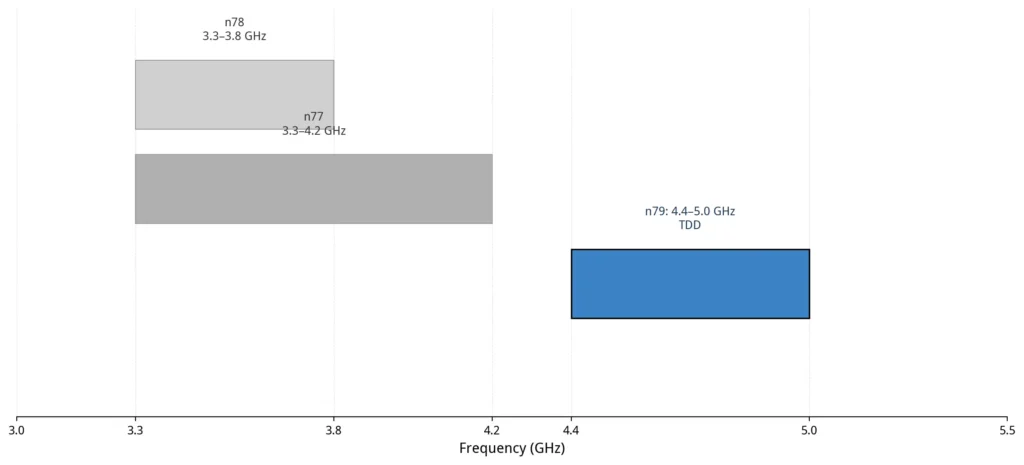
n77 covers frequencies from 3.3 GHz to 4.2 GHz, while n78 operates within 3.3 GHz to 3.8 GHz. In practice, many countries allocated spectrum within this range for 5G, which is why these two bands appear so frequently in network deployments and device specifications around the world.
· Enough Bandwidth to Matter
The biggest reason these bands became so popular is simple: capacity.
Compared with low-band spectrum, n77 and n78 support much wider channel bandwidths, allowing operators to deliver significantly higher data rates and serve more users at the same time. This gives networks the performance boost people expect from 5G without relying on mmWave deployments.
For operators, wider channels also make network planning more efficient, helping them meet growing traffic demand without dramatically increasing site density.
· A Balance That Works in the Real World
n77 and n78 sit in a practical middle ground.
They don’t travel as far as low-band spectrum such as n28 or n71, but they still provide useful coverage from a standard macro cell. At the same time, they offer far more capacity than low-band frequencies.
That balance is one of the main reasons they became the preferred choice for urban and suburban 5G rollouts. Operators can often upgrade existing sites with n77 or n78 and achieve meaningful improvements in both speed and network capacity.
· A Global Ecosystem
Spectrum fragmentation has always been a challenge in mobile networks. One reason n77 and n78 became so successful is that regulators in many regions aligned around the same C-Band spectrum range for 5G deployment.
That alignment encouraged equipment vendors, device manufacturers, and network operators to build around a common ecosystem. Today, nearly every mainstream 5G smartphone, module, router, and CPE supports n77 or n78, making them among the most widely supported 5G bands in the industry.
For operators, this means access to mature equipment and a broad device portfolio. For users, it means fewer compatibility concerns when moving between networks and regions.

· n77 vs n78: What's the Difference?
Although the two bands are often mentioned together, they are not exactly the same.
| Feature | n77 | n78 |
|---|---|---|
| Frequency Range | 3300–4200 MHz | 3300–3800 MHz |
| Spectrum Layer | Mid Band | Mid Band |
| Coverage | Very Good | Very Good |
| Capacity | Excellent | Excellent |
| Typical Use | Broad C-Band Deployments | Mainstream Global 5G |
The main difference is spectrum range. n77 covers a wider portion of C-Band spectrum, while n78 focuses on the 3.3–3.8 GHz range that became one of the most widely adopted allocations for 5G worldwide.
For most users, however, the experience is very similar. Both bands are designed to deliver the balance of coverage and performance that modern 5G networks require.
· The Bottom Line
n77 and n78 became global standards because they solve one of the biggest challenges in mobile networking: delivering much higher capacity than 4G without the deployment complexity of mmWave.
They offer wide channels, practical coverage, strong device support, and a mature global ecosystem. That combination is rare in wireless communications, and it’s why these two bands now form the backbone of many commercial 5G networks around the world.
Ⅶ. Understanding n79 and Regional 5G Deployments
n79 is a mid-band 5G NR frequency range that runs from 4400 MHz to 5000 MHz. It sits higher in the spectrum than n77 and n78, and that difference has shaped where and how the band is used.
· A Higher Mid-Band Option
Compared with n78 at 3.3–3.8 GHz, n79 offers similar channel bandwidth potential but with slightly shorter range. Signals at 4.4–5.0 GHz don’t travel quite as far and are a bit more affected by walls and other obstacles. In exchange, the band tends to be less crowded, which makes it attractive for operators that need extra capacity without moving all the way up to mmWave.
One practical advantage of n79 is that it supports wide channel bandwidths, making it a useful capacity layer in dense urban environments where lower mid-band spectrum is already heavily utilized. It’s also used in some indoor and enterprise deployments where high throughput matters more than wide-area coverage.
· Why It's Regional
The main reason n79 never became a global standard like n77 or n78 is simple: spectrum availability. Many countries did not allocate the 4.4–5.0 GHz range for mobile use. Some reserved it for government, satellite, or other services. Others already had enough mid-band spectrum in the 3.3–4.2 GHz range and didn’t need to open a new band.
As a result, n79 deployments are concentrated in a few markets, most notably China and Japan. In China, operators use n79 for capacity in dense cities and indoor systems. In Japan, parts of the 4.5 GHz range have also been assigned for 5G, giving operators another option beyond n77 and n78.
· Device and Ecosystem Support
Device support for n79 is not as universal as for n77 or n78. In regions where n79 is not deployed, many phones and modules skip it entirely. However, in China and Japan, n79 is commonly supported because local carriers use it. For global device makers, n79 is another band to include or exclude depending on the target market.
That creates a slightly fragmented ecosystem. A phone sold in Europe may not support n79, while the same model sold in China often will. It’s a practical reminder that 5G band support is still shaped by regional spectrum decisions.
· n79 vs n78:Key Differences
| Feature | n78 | n79 |
|---|---|---|
| Frequency Range | 3300–3800 MHz | 4400–5000 MHz |
| Spectrum Layer | Mid Band | Upper Mid Band |
| Coverage | Better | Shorter |
| Capacity | Excellent | Higher Potential |
| Adoption | Global | Regional |
· Why It Matters
Most 5G users will never notice whether their connection is running on n78 or n79. For operators, however, the difference can be significant.
n79 provides additional mid-band spectrum in markets where network demand continues to grow. While it doesn’t offer the global reach of n77 or n78, it gives operators another tool for expanding capacity without relying entirely on mmWave.
That’s why n79 remains an important part of the 5G spectrum landscape, even if its adoption is concentrated in only a handful of regions.
Ⅷ. How 5G Bands Work Together
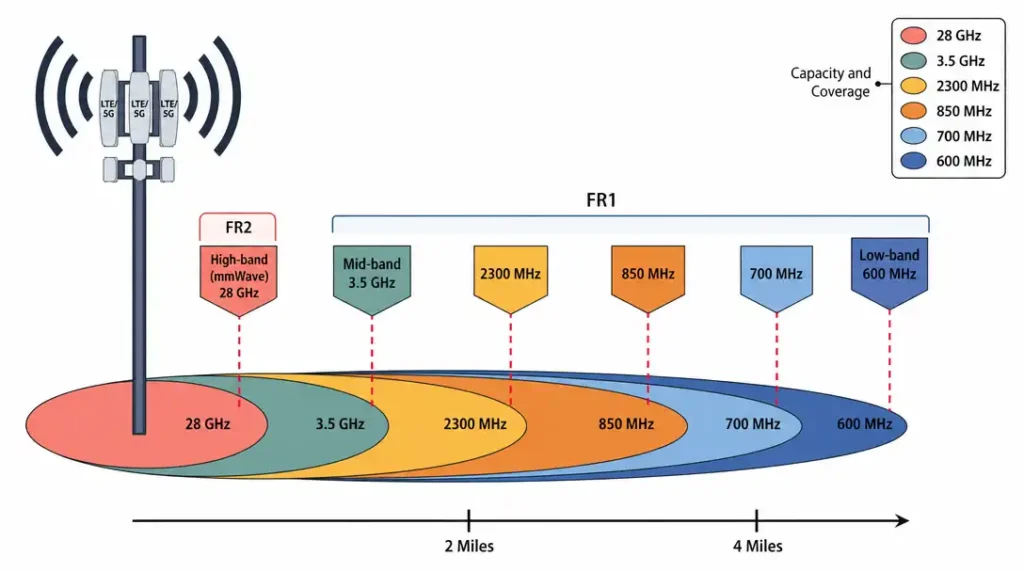
A real 5G network rarely depends on just one band. Instead, it uses several bands at the same time, each doing what it does best. Low-band keeps users connected over long distances. Mid-band carries the main load. mmWave adds extra capacity where demand is highest.
The trick is making these layers work together smoothly.
· One Network, Multiple Layers
Think of a 5G network as a team. Low-band spectrum is the wide receiver, covering big areas and keeping the connection alive. Mid-band is the all-around player, carrying most of the traffic in cities and suburbs. mmWave is the specialist, called in only for high-demand spots like stadiums or busy intersections.
Operators design their networks so that users don’t have to think about which band they’re on. The device and the network handle that automatically.
· Carrier Aggregation and Dual Connectivity
Modern 5G networks use technologies such as carrier aggregation and dual connectivity to combine different spectrum layers.
Carrier aggregation allows a device to use multiple frequency bands at the same time. For example, a phone may combine n28 for coverage with n78 for capacity, creating a connection that is both reliable and fast.
Dual connectivity works in a similar way by allowing devices to maintain connections across different network layers, helping operators improve performance and coverage as users move between environments.
· Band Switching in Real Time
As a user moves around, the device constantly checks the quality of available bands. If the mid-band signal weakens inside a building, the phone may drop back to low-band. If the user walks into a crowded area with mmWave coverage, the phone can shift to that for a short burst of extra capacity. This happens without the user noticing.
This automatic switching is not random. It is guided by network rules and device measurements, and it changes quickly based on signal strength, traffic load, and the application in use.
· What This Means for Performance
Multi-band operation changes how users experience 5G. It means:
More consistent coverage indoors and outdoors
Higher speeds where mid-band or mmWave is available
Better reliability even at the edge of coverage
More efficient use of spectrum across the whole network
In short, no single band can deliver everything. It’s the combination of bands that makes 5G feel like 5G.
Ⅸ. Final Thoughts
At the end of the day, 5G isn’t one kind of network. It’s a collection of bands that each solve a different part of the coverage and capacity problem. Some bands are built for distance. Some are built for speed. Some are built for very specific places.
That’s the real point of understanding 5G NR bands. Once you see them as tools instead of abstract numbers, it’s easier to make sense of why a phone supports n28, n41, n77, and n257 all at the same time. They’re not redundant. They’re complementary.
Low-band like n28 keeps the network honest. It reaches people indoors, in rural areas, and on the move. Mid-band like n41, n77, and n78 does the heavy lifting, delivering the everyday 5G experience most people notice. mmWave adds extreme capacity where it’s actually needed, even if it can’t go far.
The same logic applies to devices and network equipment. Whether it’s a smartphone, router, module, or antenna, performance depends on how well it supports the bands used by the network. Frequency matters, and so does the environment where the device operates.
Going forward, 5G will get more flexible, not less. Carrier aggregation, dynamic spectrum sharing, and new bands will keep adding layers. But the basic principle won’t change: no single band does everything. The networks that work best are the ones that combine bands intelligently.
If you take one thing from this article, it should be this: coverage and capacity don’t come from a single frequency band. They come from the way multiple bands work together.