
2100-2500MHz 22dBi Dual Polarized Dish Antenna
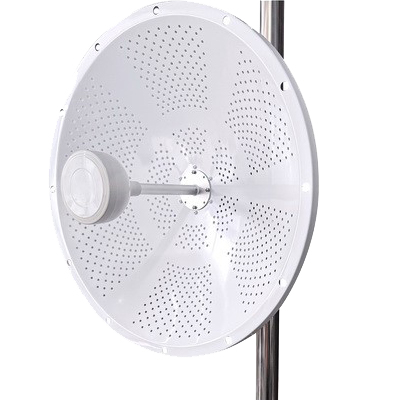
2100-2500MHz 22dBi Dual Polarized Dish Antenna
Model: APPA212521HV
Frequency Range: 2100-2500MHz
Polarization: Horizontal+Vertical
Gain: 21±1dBi
Product Descriptions
The APPA212521HV is a dual-polarized parabolic dish antenna covering 2100–2500MHz, with a gain of 21±1dBi. Its 60cm reflector and 14° beamwidth in both planes provide focused directional coverage for point-to-point wireless links. Horizontal and vertical polarization, combined with port isolation of at least 23dB, make it suitable for wireless backhaul, WISP infrastructure and remote network connections. The outdoor design supports wind speeds up to 210km/h.
Applications
- Point-to-point wireless backhaul links
- WISP network expansion and infrastructure deployment
- Private wireless networks and enterprise connectivity
- Industrial communication systems
- Rural and remote area broadband access
- Wireless surveillance and data transmission systems
Features
- High-gain directional design for long-distance links
- Dual polarization enhances signal stability and throughput
- Narrow beamwidth reduces interference from adjacent networks
- Excellent front-to-back ratio for cleaner signal performance
- Durable construction for reliable outdoor deployment
- DC grounding for enhanced lightning and surge protection
Product Specifications
Electrical Specifications
| Frequency Range | 2100–2500 MHz |
| Polarization | Horizontal + Vertical |
| Gain | 21 ± 1 dBi |
| VSWR | ≤ 1.8 |
| Horizontal Beamwidth | 14° ± 2° |
| Vertical Beamwidth | 14° ± 2° |
| F/B Ratio | ≥ 25 dB |
| Isolation | ≥ 23 dB |
| Nominal Impedance | 50 Ω |
| Maximum Power | 50 W |
| Lightning Protection | DC Ground |
Mechanical Specifications
| Connector | 2xN-female with pigtail |
| Mounting Mast Size | Φ40–85 mm |
| Dish Size | Φ 60 cm |
| Weight | 3.9 kg |
| Max. Wind Velocity | 210 km/h |
| Operating Temperature | -40~+65 ℃ |
Antenna Pattern
2200MHz
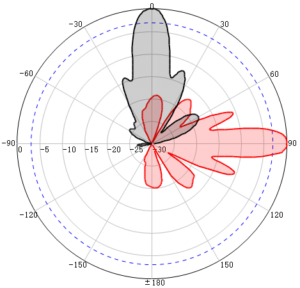
H-Plane
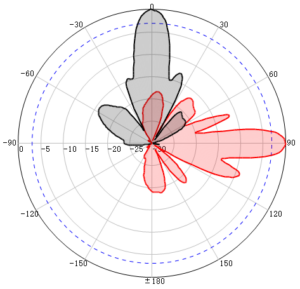
E-Plane
2500MHz
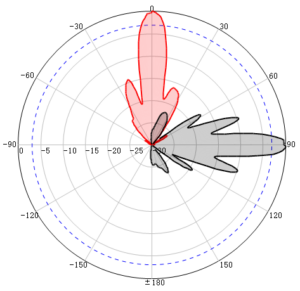
H-Plane
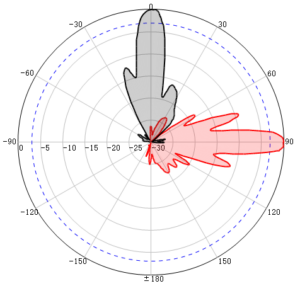
E-Plane
PRODUCT SUPPORT
FAQ - 2.4GHz WiFi Antenna
No. A higher dBi antenna reshapes the signal pattern rather than creating more signal power. It stretches coverage horizontally but reduces vertical reach, so devices directly above or below the antenna may actually see a weaker signal. For indoor use where devices sit on the same floor, a moderate-gain antenna often performs better than an excessively high-gain one.
An omnidirectional antenna radiates in a 360° donut-shaped pattern, making it suitable for covering a room, office floor, or warehouse where devices are spread around the access point. A directional antenna focuses the signal into a narrower beam, delivering stronger signal and longer reach in one specific direction—ideal for point-to-point links or a single distant device.
22dBi is sufficient for most practical point-to-point links; 24dBi is not automatically “better.” Comparable 22dBi dual-polarized dishes are specified for long-range point-to-point, point-to-multipoint and wireless bridge applications in the 2.4GHz band. The 22dBi version has a slightly wider beam than a 24dBi dish, which makes initial alignment more forgiving. For links where extreme distance is not the constraint, 22dBi often delivers a more stable installation.
Usually yes, or with a short pigtail. This antenna uses 2×N-female connectors. Many outdoor radios—MikroTik Groove/BaseBox, Ubiquiti Bullet, airFiber—use N-type or RP-SMA ports. For radios with N-female, you need an N-male to N-male jumper; for radios with RP-SMA, an N-female to RP-SMA-male pigtail is required. Consumer indoor routers with RP-SMA also need the same pigtail; direct N-to-RP-SMA connection is not possible.
Yes, in both roles, but for different reasons. As a WISP CPE antenna, a 22dBi dish concentrates gain toward a distant tower and supports fixed wireless access in areas without fiber. As a building-to-building backhaul, its directional pattern and ≥25dB front-to-back ratio help reject interference from adjacent networks. It is a point-to-point / CPE antenna, not a sector—do not expect it to cover many nearby customers in different directions.
Dual polarization enables 2×2 MIMO operation. A single-polarization dish forces a MIMO radio to run at reduced spatial-stream capability; two orthogonal polarizations give the radio the independent paths it needs to transmit two data streams and maintain rated throughput. On a clean line-of-sight link, the practical result is higher and more consistent throughput, not longer distance—distance is determined primarily by link budget and radio sensitivity.
Please feel free to contact us by info@airpluxtec.com for more detailed info if you’re interested in this 2100-2500MHz 22dBi Dual Polarized Dish Antenna, or please check here for our more WIFI Antenna products.
Contact
We are always ready to serve you.
Please feel free to contact us
for any antenna inquiry or requirement.
Leave us a message in the form below and
we will get back to you within 24 hours.