
2.4GHz 18dBi SISO Outdoor Panel Antenna
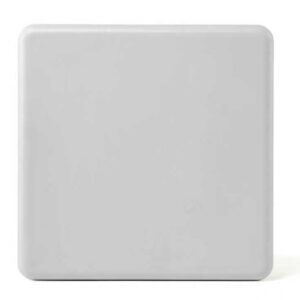
2.4GHz 18dBi SISO Outdoor Panel Antenna
Model: APOPA2425V18
Frequency Range: 2400-2500MHz
Polarization: Vertical
Gain: 18±1dBi
Product Descriptions
The APOPA2425V18 is a vertically polarized 18dBi directional panel antenna for 2400–2500MHz wireless applications. Its 20° beamwidth in both horizontal and vertical planes provides focused coverage, while the front-to-back ratio of at least 25dB helps limit reception from the rear of the antenna. With a slim 305 × 305mm ABS housing, it is suitable for point-to-point wireless bridges, outdoor WiFi connections and remote surveillance systems.
Applications
- Long-distance point-to-point wireless links between buildings, farms, warehouses, or remote facilities.
- Point-to-multipoint outdoor WiFi coverage for parks, campuses, industrial zones, and municipal networks.
- Wireless video surveillance systems, providing stable uplinks for IP cameras over large areas.
- Rural broadband extension, enabling ISPs and WISPs to deliver connectivity in underserved regions.
- Outdoor AP and CPE equipment upgrades to improve range, signal strength, and network reliability.
Features
- High-gain 18dBi directional performance for long-distance WiFi coverage.
- Narrow 20° beamwidth for improved focus and reduced signal interference.
- Excellent >25dB F/B ratio for stable and clean communication links.
- Weather-resistant ABS housing and wide temperature tolerance for outdoor reliability.
- SISO design optimized for simplicity, cost-efficiency, and strong single-path performance.
Product Specifications
Electrical Specifications
| Model | APOPA2425V18 |
| Frequency Range | 2400–2500 MHz |
| Gain | 18 ± 1 dBi |
| Horizontal Beamwidth | 20 ± 3° |
| Vertical Beamwidth | 20 ± 3° |
| VSWR | ≤ 1.8 |
| Impedance | 50 Ω |
| Polarization | Vertical |
| Max. Power | 50 W |
| Connector | N-Female |
| Lightning Protection | DC Ground |
Mechanical Specifications
| Dimension | 305 × 305 × 25 mm |
| Weight | 1.2 kg |
| Rated Wind Velocity | 36.9 m/s |
| Operational Humidity | < 95% |
| Operating Temperature | -40~55 ℃ |
| Radome Material | ABS |
Antenna Pattern
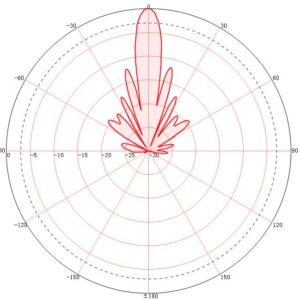
H-Plane
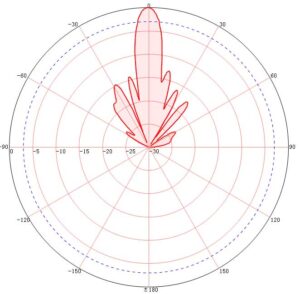
E-Plane
PRODUCT SUPPORT
FAQ - 2.4GHz WiFi Antenna
No. A higher dBi antenna reshapes the signal pattern rather than creating more signal power. It stretches coverage horizontally but reduces vertical reach, so devices directly above or below the antenna may actually see a weaker signal. For indoor use where devices sit on the same floor, a moderate-gain antenna often performs better than an excessively high-gain one.
An omnidirectional antenna radiates in a 360° donut-shaped pattern, making it suitable for covering a room, office floor, or warehouse where devices are spread around the access point. A directional antenna focuses the signal into a narrower beam, delivering stronger signal and longer reach in one specific direction—ideal for point-to-point links or a single distant device.
Not necessarily. SISO uses a single antenna for transmit and receive, while MIMO uses multiple antennas and multiple data streams to achieve higher throughput and better signal reliability. But MIMO’s benefit depends on the radio at both ends being MIMO-capable and the RF channel being clean enough to support multiple spatial streams. If your radio is SISO, or the far end is a single-chain CPE, a well-matched SISO antenna like this 18dBi panel delivers the same directional gain without paying for a second RF chain you cannot use. It is the simpler, lower-cost choice for links where throughput demand is moderate and hardware compatibility points to SISO.
Comparable 18dBi 2.4GHz directional panels are specified for theoretical distances up to 5 km at 11 Mbps and up to 8 km at 1 Mbps when paired with external access points, based on 19 dBm transmit power and standard cable loss. These are theoretical link-budget figures, not guarantees. Real achievable distance depends on the far-end antenna, radio sensitivity, cable quality, and fresnel zone clearance—trees, rooftops, or terrain intruding into the path will reduce range well below the published maximum. Treat 5 km as a realistic planning baseline for a matched pair in clean line-of-sight.
It depends on the radio’s port. This antenna uses a single N-Female connector. N-Female is the standard outdoor RF interface, but consumer routers and many SOHO access points use RP-SMA, which is not directly compatible. For a radio with an N-Female port, you need an N-Male to N-Male jumper. For a device with RP-SMA, you need an N-Male to RP-SMA-Male pigtail—TP-Link, for example, provides such pigtails precisely because its outdoor N-Female antennas cannot mate directly with its RP-SMA routers. Direct N-to-RP-SMA connection is not possible without an adapter.
Most outdoor panel antennas perform best when installed 5–15 meters above ground, high enough to clear roofs, walls, and nearby trees while maintaining line-of-sight. Height alone is not the goal—fresnel zone clearance matters more than absolute elevation. For aiming, do not point by eye. Establish a live RSSI reading at the radio, pre-point on the compass bearing, then sweep slowly in azimuth and elevation, pausing at each position for the reading to settle. Confirm you are on the main lobe by sweeping past the apparent peak in both directions, and tighten the mount as part of the alignment process—tightening almost always nudges the antenna, so re-read RSSI afterward to prove the aim did not shift. An antenna that sways in wind will move its beam out of the target area even if it survives the weather.
Please feel free to contact us by info@airpluxtec.com for more detailed info if you’re interested in this 2.4GHz Dual Polarity Parabolic Dish Antenna, or please check here for our more WIFI Antenna products.
Contact
We are always ready to serve you.
Please feel free to contact us
for any antenna inquiry or requirement.
Leave us a message in the form below and
we will get back to you within 24 hours.