
2.4GHz 12dBi Omni Fiberglass Antenna
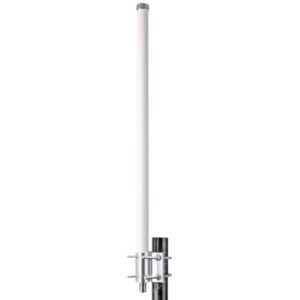
2.4GHz 12dBi Omni Fiberglass Antenna
Model: APOFA2400V12
Frequency Range: 2400-2500MHz
Polarization: Vertical
Gain: 12±1dBi
Product Descriptions
The APOFA2400V12 is a vertically polarized omnidirectional antenna operating at 2400–2500MHz. Its 12dBi gain and 360° horizontal coverage make it suitable for distributing wireless signals across open areas without requiring directional alignment. The 1200mm fiberglass radome is designed for outdoor pole mounting and long-term exposure to changing weather conditions. Typical applications include outdoor WiFi base stations, WISP networks, industrial wireless systems and wide-area surveillance connectivity.
Applications
- Rural and suburban broadband coverage, extending signal from a central AP to remote homes or buildings.
- Outdoor WiFi networks for parks, campuses, stadiums, marinas, theme parks, and resorts.Industrial wireless systems, including factories, logistics hubs, agricultural IoT, and mining sites.
- Wireless video surveillance, offering reliable backhaul for long-distance IP cameras.
- Point-to-multipoint (P2MP) links, connecting multiple clients or nodes across large areas.
- Temporary or event-based networks, including exhibitions, construction sites, and outdoor fairs.
Features
High 12dBi omni gain for extended coverage and improved link stability.
Rugged fiberglass radome for UV, rain, and corrosion resistance.
Vertical polarization compatible with most 2.4GHz routers, APs, and CPEs.
Low VSWR (≤1.5) ensures efficient signal transmission and reduced power loss.
Lightweight 1200mm body for easy pole mounting in outdoor environments.
Reliable performance in extreme weather, suitable for long-term outdoor use.
Product Specifications
Electrical Specifications
| Model | APOFA2400V12 |
| Frequency Range | 2400–2500 MHz |
| Gain | 12 ± 1 dBi |
| Horizontal Beamwidth | 360° |
| Vertical Beamwidth | 15 ± 3° |
| VSWR | ≤ 1.5 |
| Impedance | 50 Ω |
| Polarization | Vertical |
| Max. Power | 50 W |
| Connector | N-Male |
| Lightning Protection | DC Ground |
Mechanical Specifications
| Dimension | Φ20 × 1200 mm |
| Weight | 1.2 kg |
| Rated Wind Velocity | 36.9 m/s |
| Operational Humidity | < 95% |
| Operating Temperature | -40~55 ℃ |
| Radome Material | Fiberglass |
PRODUCT SUPPORT
FAQ - 2.4GHz WiFi Antenna
No. A higher dBi antenna reshapes the signal pattern rather than creating more signal power. It stretches coverage horizontally but reduces vertical reach, so devices directly above or below the antenna may actually see a weaker signal. For indoor use where devices sit on the same floor, a moderate-gain antenna often performs better than an excessively high-gain one.
An omnidirectional antenna radiates in a 360° donut-shaped pattern, making it suitable for covering a room, office floor, or warehouse where devices are spread around the access point. A directional antenna focuses the signal into a narrower beam, delivering stronger signal and longer reach in one specific direction—ideal for point-to-point links or a single distant device.
Comparable 12dBi 2.4GHz omni antennas are marketed for potential range up to several miles when paired with a commercial-grade AP or bridge, with some consumer units claiming up to 2 miles in ideal conditions with no obstacles or interference. Link-budget calculations for a 12dBi omni at the AP end commonly put usable range in the 4–5 km region under favourable assumptions. Treat 2–3 km as a realistic planning baseline for a clean outdoor site, and expect shorter coverage in cluttered or noisy RF environments. An omni radiates in 360°, so it cannot concentrate energy toward a distant client the way a panel or dish does.
It is a SISO antenna. This antenna has a single N-Male connector and vertical polarization only; it does not provide the two independent polarization paths that a MIMO radio needs to run 2×2 spatial multiplexing. If you connect it to a MIMO AP, the radio will operate in a reduced spatial-stream configuration—you will not get the throughput benefit of the AP’s second chain. This is the correct choice for SISO APs, legacy 802.11b/g radios, single-chain CPEs, or deployments where the far-end clients are vertical-only and MIMO gain would not be realized anyway.
Mount the antenna above the main obstruction field and keep it clear of metal surfaces that would detune the pattern. For a vertical collinear antenna on a metal mast, mount it at least 30 cm (12 inches) above the top of the mast; if the antenna must run alongside a metal mast, use a non-conductive standoff bracket and maintain at least a quarter-wavelength (≈8 cm) standoff from the metal surface. On a metal roof, extend the mast at least 0.5 m above the roofline to clear the roof’s RF reflection zone. Mounting an omni directly against a metal pole is a common installation error that distorts the 360° pattern.
Yes, for the radome material itself. Fiberglass (FRP) has higher UV and salt-spray resistance than ordinary ABS, making it better suited to coastal, saline-alkali, and snow/rain-heavy mountain environments. Fiberglass radomes are also commonly specified for protection against corrosive gases, UV radiation, icing, salt spray, and acid rain. However, the radome material alone does not guarantee the connector seal or long-term performance: in persistent salt-fog or high-acid environments, inspect and clean the nickel-plated N connector and sealing components periodically, and budget for seal replacement at roughly five-year intervals if the site is severe.-
Please feel free to contact us by info@airpluxtec.com for more detailed info if you’re interested in this 2.4GHz 12dBi Omni Fiberglass Antenna, or please check here for our more WIFI Antenna products.
Contact
We are always ready to serve you.
Please feel free to contact us
for any antenna inquiry or requirement.
Leave us a message in the form below and
we will get back to you within 24 hours.