
2.1-2.5GHz 24dBi 4-Part Pizza Dish Antenna
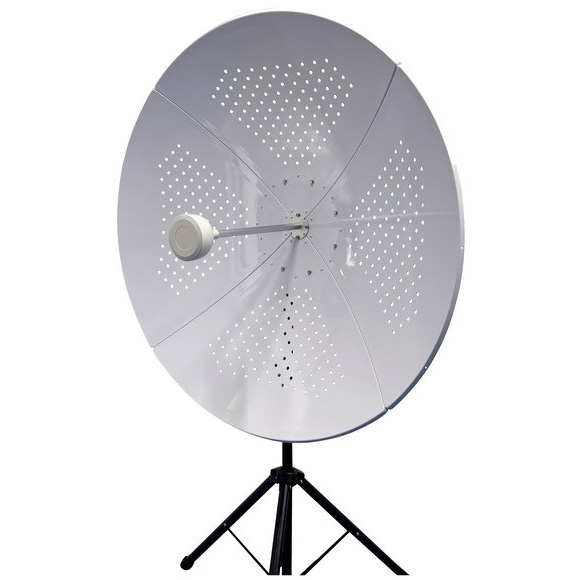
2.1-2.5GHz 24dBi 4-Part Pizza Dish Antenna
Model: APPDA212524HV
Frequency Range: 2100-2500MHz
Polarization: Horizontal+Vertical
Gain: 24±1dBi
Product Descriptions
The APPDA212524HV is a 24dBi dual-polarized parabolic dish antenna operating from 2.1 to 2.5GHz. Its 90cm reflector provides a narrow beamwidth of 8° horizontal and 7° vertical, making it suitable for long-distance point-to-point wireless links.
With horizontal and vertical polarization and a front-to-back ratio of at least 25dB, it is designed for directional signal transmission in wireless backhaul, FWA and bridge applications. The rugged outdoor construction supports wind speeds up to 210km/h, while DC-ground lightning protection provides additional protection against electrical surges.
Applications
- Point-to-point wireless backhaul links
- Fixed wireless access (FWA) networks
- Wireless bridge connections between buildings
- Private network and industrial communication systems
- Rural and remote area connectivity projects
Features
- 24dBi high-gain directional performance
- Narrow beamwidth for long-distance links
- Dual polarization for improved link stability
- High front-to-back ratio reduces interference
- Rugged outdoor design with wind resistance
Product Specifications
Electrical Specifications
| Frequency Range | 2.1–2.5 GHz |
| Polarization | Horizontal + Vertical |
| Gain | 24 ± 1 dBi |
| VSWR | ≤ 2.0 |
| Horizontal Beamwidth | 8° ± 0.5° |
| Vertical Beamwidth | 7° ± 0.5° |
| F/B Ratio | ≥ 25 dB |
| Nominal Impedance | 50 Ω |
| Maximum Power | 50 W |
| Lightning Protection | DC Ground |
Mechanical Specifications
| Connector | 2xN-female with pigtail or Customized |
| Mounting Mast Size | Φ30–50 mm |
| Dish Size | Φ 90 cm |
| Weight | 7.5 kg |
| Max. Wind Velocity | 210 km/h |
| Operating Temperature | -40~+65 ℃ |
Antenna Pattern
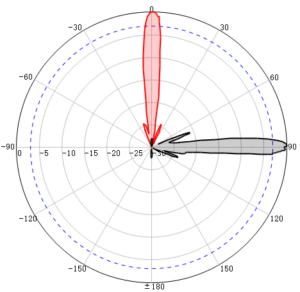
H-Plane
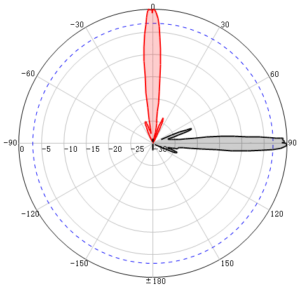
E-Plane
PRODUCT SUPPORT
FAQ - 2.4GHz WiFi Antenna
No. A higher dBi antenna reshapes the signal pattern rather than creating more signal power. It stretches coverage horizontally but reduces vertical reach, so devices directly above or below the antenna may actually see a weaker signal. For indoor use where devices sit on the same floor, a moderate-gain antenna often performs better than an excessively high-gain one.
An omnidirectional antenna radiates in a 360° donut-shaped pattern, making it suitable for covering a room, office floor, or warehouse where devices are spread around the access point. A directional antenna focuses the signal into a narrower beam, delivering stronger signal and longer reach in one specific direction—ideal for point-to-point links or a single distant device.
Yes. This is its primary deployment role. A 24dBi dish is a point-to-point / backhaul antenna, not a coverage antenna. Comparable 24dBi 2×2 MIMO dishes in this class are specified for links up to 30 km under clear line-of-sight. For two rural buildings separated by several kilometers with no fiber path, pairing this dish with a matching dish and a MIMO outdoor radio is a standard, cost-effective backhaul solution.
No. The DC-ground design provides a path from the antenna’s metallic structure to the radio’s ground reference, but it does not replace a proper external grounding system. Industry installation guidelines require the antenna mast or tower base to be connected directly to the building’s protective ground or to one or more approved grounding rods. The DC-ground feature is a supplement to—not a substitute for—site grounding and a surge arrestor on the feedline.
Dual polarization provides polarization diversity, not immunity. In environments where one polarity is heavily interfered with and the other is clean, a 2×2 MIMO radio will typically still operate, but throughput may drop because the radio is constrained by the weaker chain. The benefit of H+V is that it gives the radio a second, independent path when both polarities are usable; it does not guarantee full MIMO throughput when one polarity is persistently degraded. Site survey with a spectrum analyzer before committing to a link is advisable.
The decision is driven by link budget and radio compatibility, not by one band being universally superior. 2.4 GHz has lower free-space path loss than 5 GHz, which helps on marginal long links, and it is the only option when one or both radios operate in 2.1–2.5 GHz. 5 GHz offers more clean channels and higher peak throughput at shorter ranges. For a long-distance, unlicensed, moderate-throughput backhaul or CPE link where the radios are 2.4GHz, this dish remains the appropriate antenna class.
Please feel free to contact us by info@airpluxtec.com for more detailed info if you’re interested in this 2.1-2.5GHz 24dBi 4-Part Pizza Dish Antenna, or please check here for our more WIFI Antenna products.
Contact
We are always ready to serve you.
Please feel free to contact us
for any antenna inquiry or requirement.
Leave us a message in the form below and
we will get back to you within 24 hours.