
How to Choose the Right RF Cable and Connector?
How to Choose
the Right RF Cable?
Introduction
When selecting an antenna for an RFID, WiFi, cellular, GNSS, or other RF communication system, most people focus on parameters such as frequency, gain, and radiation pattern. While these specifications are certainly important, the RF cable and connectors between the radio and the antenna are often overlooked.
In reality, even a high-performance antenna cannot deliver its expected performance if too much signal is lost before it reaches the antenna. A properly selected RF cable helps reduce attenuation, maintain signal integrity, and improve the overall efficiency of the system. Likewise, choosing compatible connectors ensures a reliable electrical and mechanical connection that can withstand long-term operation.
This article explains how RF cables work, what affects their performance, and how to choose the right cable and connector for different applications.
I. What Does an RF Cable Do?
An RF cable, also known as a coaxial cable, carries radio frequency signals between RF equipment and the antenna. In a typical installation, the signal leaves the reader, router, modem, or radio, passes through a connector, travels along the coaxial cable, and finally reaches the antenna, where it is transmitted into free space.
Although this may seem like a simple connection, every cable introduces a certain amount of signal loss. This loss, known as attenuation, is unavoidable, but it can be minimized by choosing a cable with suitable electrical characteristics. The lower the attenuation, the more RF power reaches the antenna and the better the overall system performs.
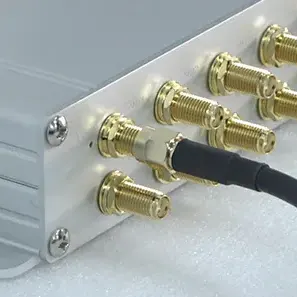
II. How Does a Coaxial Cable Work?
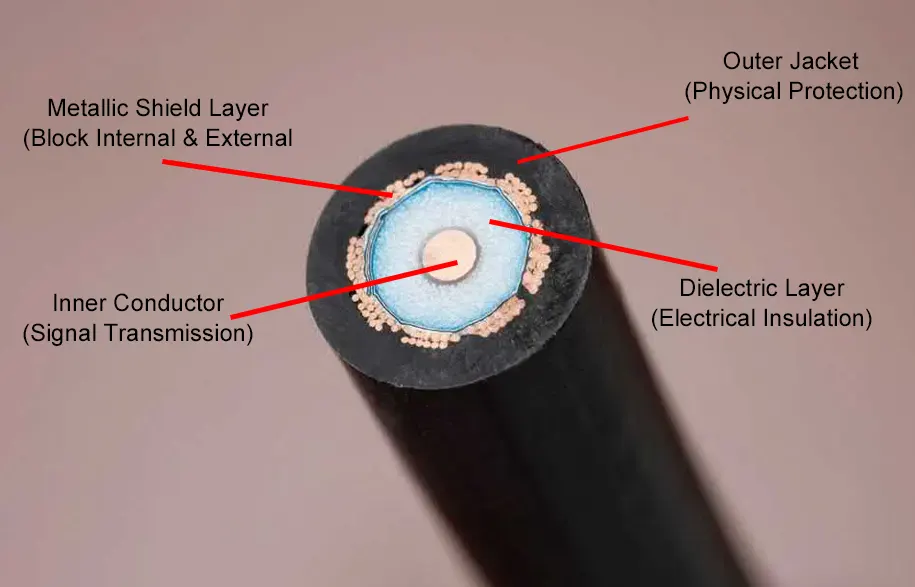
A coaxial cable is specifically designed to carry high-frequency RF signals while minimizing interference from the surrounding environment.
Its construction consists of a center conductor that carries the signal, a dielectric layer that provides electrical insulation, a metallic shielding layer that prevents signal leakage and blocks external interference, and an outer jacket that protects the cable from physical damage.
Because of this layered structure, coaxial cables provide stable signal transmission in both indoor and outdoor RF systems. However, not all cables are built the same. Their materials, shielding quality, and diameter all influence how efficiently they transmit RF energy.
III. What Should You Consider When Choosing an RF Cable?
Selecting an RF cable involves more than simply finding one with the right connector. Several factors work together to determine how well a cable will perform in a particular application.
Operating frequency
The first consideration is the operating frequency. Every cable is designed to support a specific frequency range, and signal attenuation generally increases as frequency rises. A cable that performs well in a UHF RFID system may not be the best choice for a 6 GHz wireless application. Selecting a cable that comfortably covers the required frequency helps maintain signal quality throughout the transmission path.
Length
Length is another important factor. As the cable becomes longer, the signal has to travel a greater distance, resulting in higher attenuation. For this reason, it is generally recommended to keep cable runs as short as practical. If a long cable cannot be avoided, using a lower-loss cable becomes even more important.
Attenuation is usually specified in decibels per 100 meters (dB/100 m) and indicates how much RF power is lost during transmission. A lower attenuation value means more signal reaches the antenna. This specification is often more meaningful than simply comparing cable diameters because it directly reflects transmission efficiency.
Easy installation
Flexibility should also be considered during installation. Cables with lower attenuation are typically thicker and provide better shielding, but they are also heavier and less flexible. Thin cables are easier to route inside equipment or through narrow spaces, while larger cables are generally preferred for outdoor installations or long transmission distances where minimizing signal loss is the priority.
IV. Comparing Common RF Cable Types
1/2 Cable
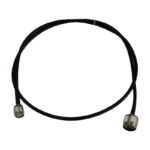
RF195
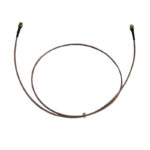
3D-FB
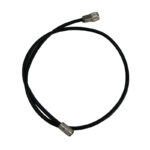
RG316
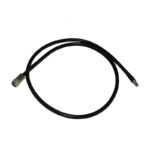
5D-FB
7D-FB
| Model | Frequency Range | Standard Connectors | Impedance | Attenuation (per 100m) | Operating temperature |
| 1/2 Cable | 0 – 17,000 MHz | N-Male to N-Male | 50Ω | 10.55 dB | -55-85°C |
| RF195 | 0 – 3,000 MHz | SMA-Male to SMA-Male | 50Ω | 25.4 dB | -20-70°C |
| 3D-FB | 0 – 6 GHz | SMA-Male to SMA-Male | 50Ω | 43.0 dB | -40-60°C |
| RG316 | 800MHz – 1GHz | MMCX RA to SMA-Male | 50Ω | 88.0 dB | -20-70°C |
| 5D-FB | 800MHz – 1GHz | N-Male to SMA-Male | 50Ω | 22.6 dB | -20-70°C |
| 7D-FB | 0 – 6 GHz | N-Female to SMA-Female | 50Ω | 14.1 dB | -20-70°C |
Cable length can be customized as required (including connectors).
Each cable has its own advantages. RG316 is lightweight and highly flexible, making it suitable for compact devices where space is limited. RF195 offers a good balance between flexibility and performance, making it a popular choice for RFID and WiFi installations. For projects requiring longer cable runs, 5D-FB and 7D-FB provide lower attenuation and help preserve signal strength over distance. When the installation involves high power or outdoor infrastructure, a 1/2-inch feeder cable is usually the preferred option because of its excellent shielding and very low signal loss.
V. Understanding RF Connectors
Several connector types are commonly used in RF systems, including SMA, N Type, MMCX, TNC, and BNC. Each connector has its own dimensions and mechanical design, so different connector families cannot be connected directly to one another.
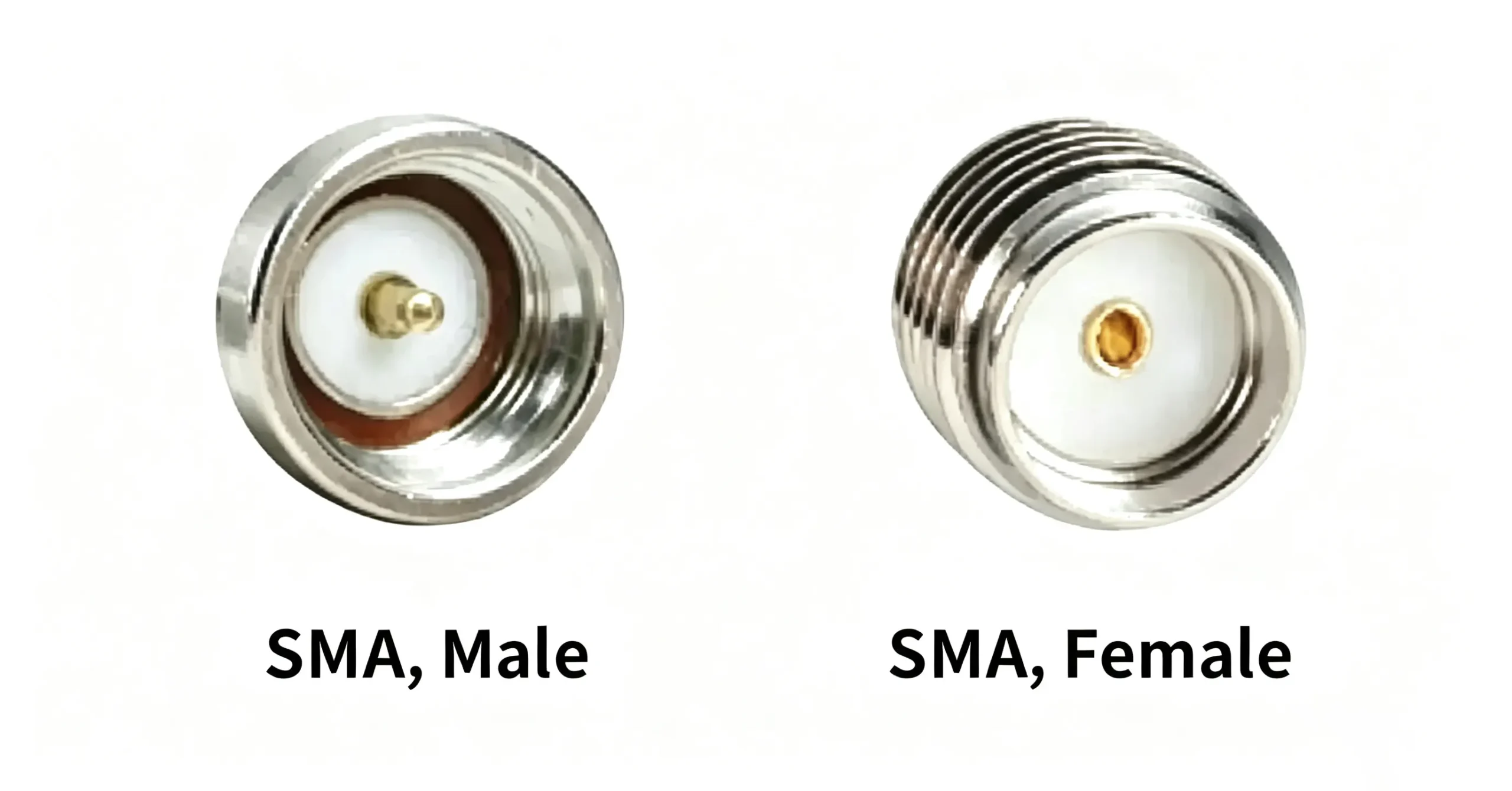 SMA Wireless networks, satellite positioning, RFID modules Compact size, wide frequency band, reliable, cost-effective
 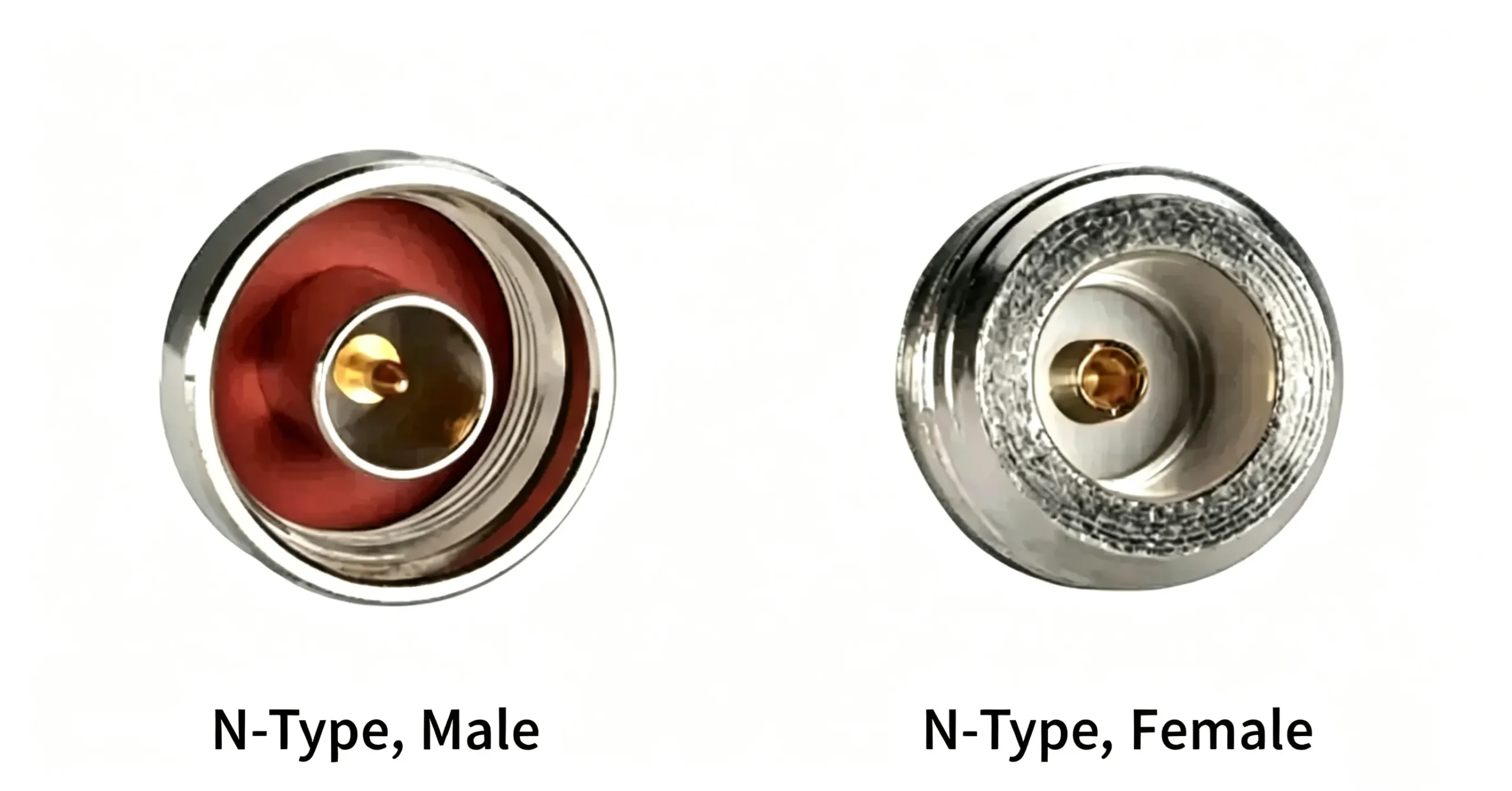 N-Type Outdoor antennas, RFID readers/writers, communication base stations Rotating locking mechanism, high power handling, robust connection
 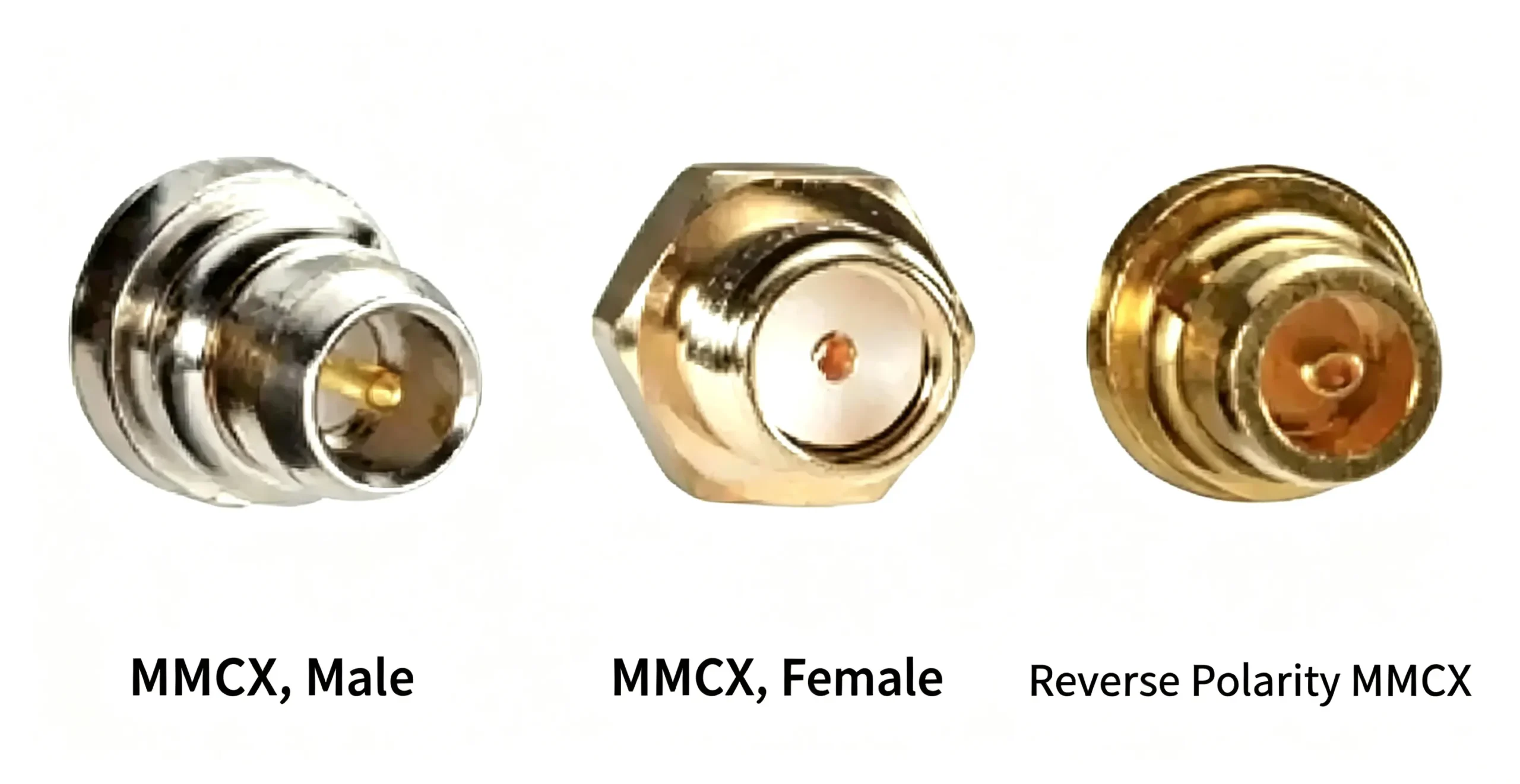 MMCX Compact wireless modules Push-on connection, strong adaptability
 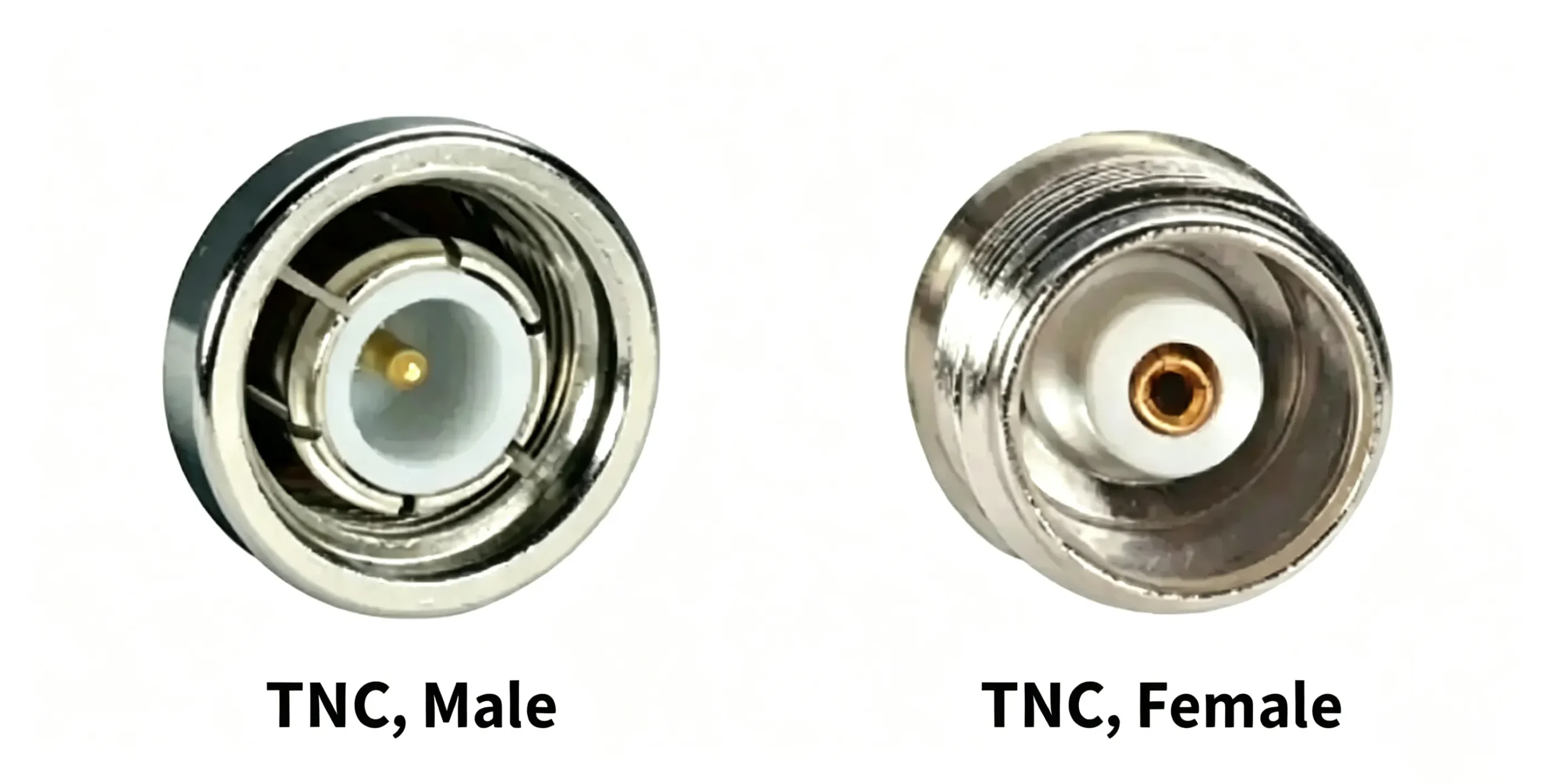 TNC RF communication equipment High vibration resistance, high reliability
 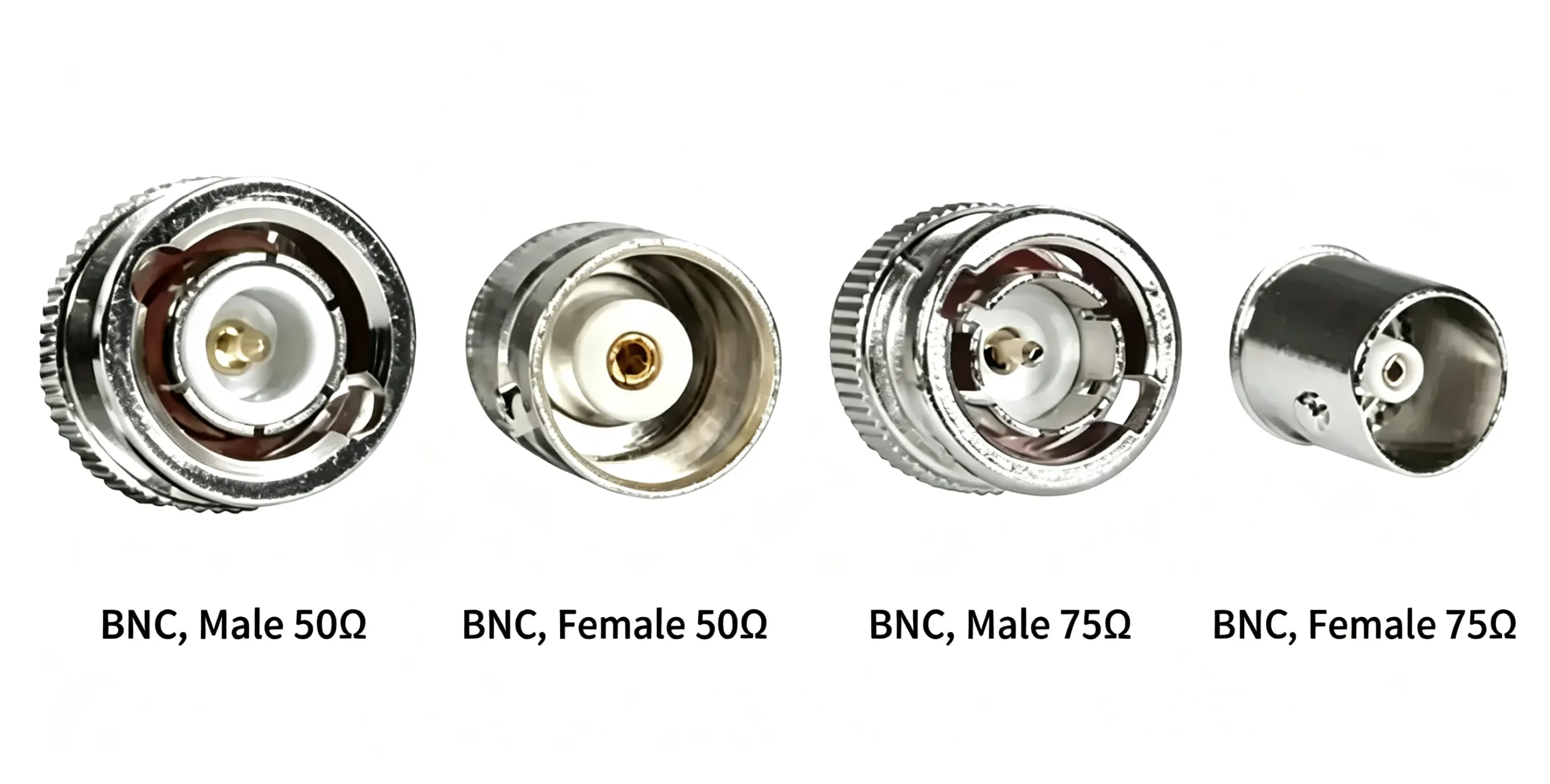 BNC Test and measurement equipment Quick connect/disconnect, low cost, strong compatibility
When selecting a cable assembly, it is important to verify that the connector type matches both the antenna and the RF device.
VI. Male and Female Connectors
Besides the connector family, connector gender must also be considered. In most standard RF connectors, the male connector has internal threads and a center pin, while the female connector has external threads and a center socket. The thread position provides a quick way to identify the connector gender, while the center pin or socket confirms the electrical connection. Both the connector type and the gender must match for a proper connection.
For example, an SMA male connector mates with an SMA female connector, and an N male connector mates with an N female connector. An SMA connector cannot be connected directly to an N connector, even if both are male or both are female, because they belong to different connector families.
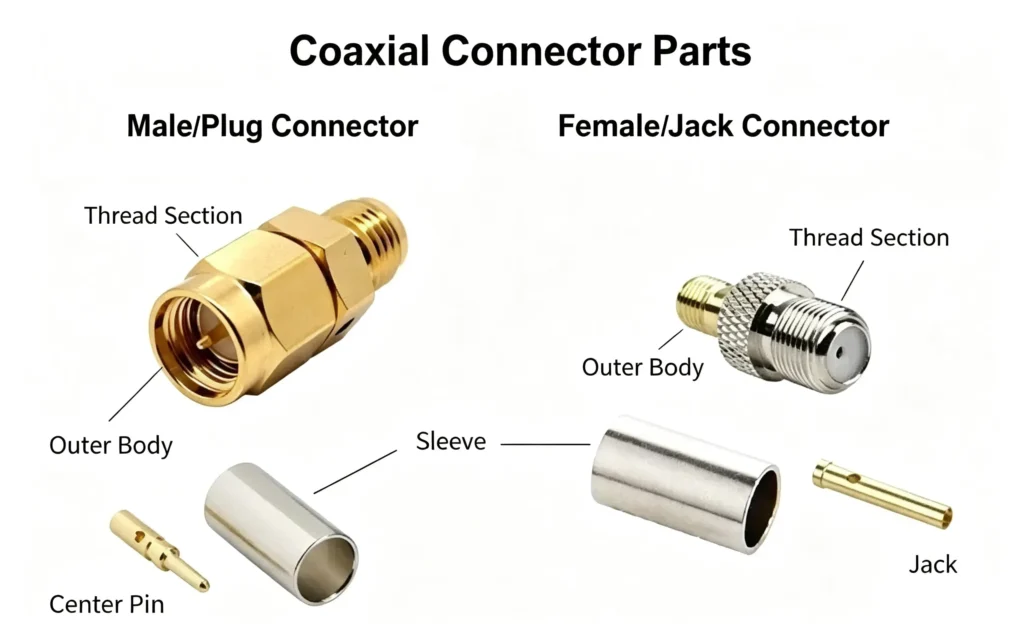
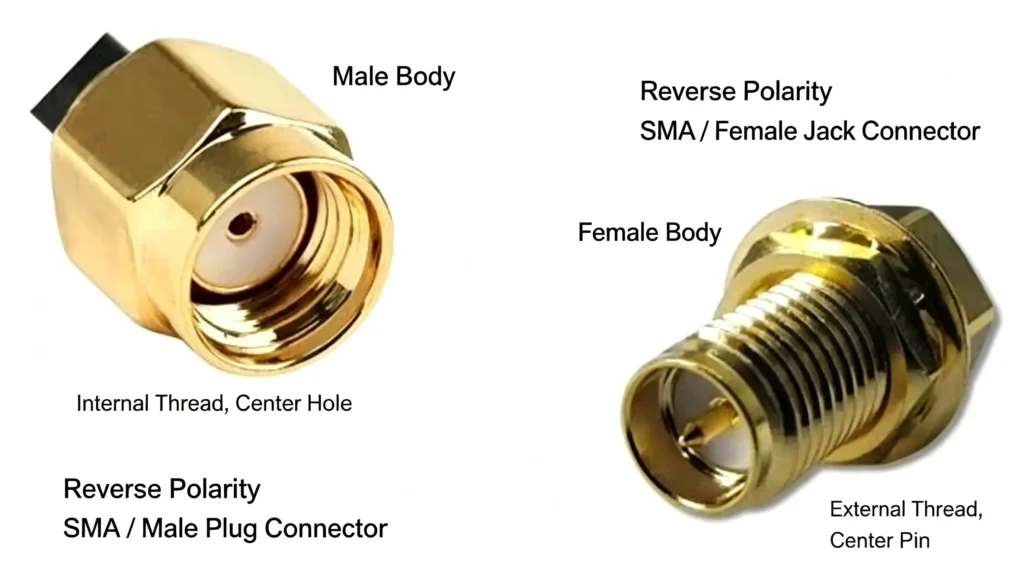
Some wireless devices also use reverse-polarity (RP) connectors, particularly RP-SMA and RP-TNC. Although the thread orientation remains the same as standard connectors, the center pin and socket are intentionally reversed. For example, an RP-SMA male connector has internal threads but a center socket instead of a center pin, while an RP-SMA female connector has external threads with a center pin. Because RP connectors look very similar to their standard counterparts, they are often mistaken for one another, so it is always recommended to verify the connector specification before purchasing a cable or adapter.
VII. Avoiding Common Selection Mistakes
Many RF performance issues are not caused by the antenna itself but by inappropriate cable selection. One of the most common mistakes is choosing a cable based only on price while ignoring its attenuation characteristics. Another is using a cable that is much longer than necessary, which increases signal loss without providing any benefit.
Connector compatibility is another area where mistakes frequently occur. Ordering the wrong connector type or connector gender can delay installation and require additional adapters. It is also important to consider the installation environment. A cable intended for indoor use may not provide sufficient protection against moisture, sunlight, or extreme temperatures when installed outdoors.
Taking a few minutes to confirm the cable specifications before installation can help avoid unnecessary troubleshooting later.
VIII. Why Cable Quality Matters
The cable is the link between your RF equipment and the antenna, so its quality has a direct influence on overall system performance. A well-designed cable with appropriate shielding and low attenuation helps deliver more RF power to the antenna, resulting in more reliable communication, better wireless coverage, and improved system efficiency.
Although the cable is often one of the least expensive components in an RF system, its impact on performance should not be underestimated. Choosing a cable that matches your frequency, transmission distance, and installation environment is a simple way to improve system reliability without changing the antenna or radio.
Conclusion
Choosing the right RF cable is about more than simply finding a cable that fits the connector on your equipment. Frequency range, cable length, attenuation, connector compatibility, and the installation environment all influence how efficiently RF energy reaches the antenna.
By understanding these factors, you can select a cable that supports the performance of your entire RF system rather than limiting it. A suitable cable and connector combination not only reduces signal loss but also improves long-term reliability and simplifies installation.
If you are unsure which cable best suits your application, the Airplux team can help you choose or customize a cable assembly based on your frequency band, connector requirements, installation environment, and cable length.
You may also like

Why do RF systems use 50 ohm impedance? Explore the trade-offs between power handling, transmission loss, coaxial design, and system compatibility.
Master VSWR vs Return Loss — how they indicate mismatch, reflected power, and why both matter in RF antenna systems.

Learn what antenna efficiency means, how radiation and total efficiency differ, and how VSWR and gain affect antenna performance.
Contact
We are always ready to serve you.
Please feel free to contact us
for any antenna inquiry or requirement.
Leave us a message in the form below and
we will get back to you within 24 hours.
About Us
Airplux Technologies Limited is one professional Antenna Solution Provider which is integrating R&D, production and sales of antennas. Airplux manufactures superior quality DAS/Small Cell antennas, WiFi antennas, IOT/RFID/M2M/GPS antennas, Base Station antennas and customized antennas from 100MHz to 80GHz. Airplux specializes in the production of custom antennas and related accessories.
Working Hours
- Monday - Friday: 8:00 - 18:00
- Saturday: 8:00 - 12:00
We are always ready to serve you.
Please send email to info@airpluxtec.com,
we will get back to you within 24 hours.