
How to Choose the Best LoRa Antenna?
Wondering what the best LoRa antenna is? From impedance and gain to outdoor fiberglass solutions, this article explains everything you need to know before choosing the right LoRaWAN antenna.
Wondering what the best LoRa antenna is? From impedance and gain to outdoor fiberglass solutions, this article explains everything you need to know before choosing the right LoRaWAN antenna.
LoRa, short for Long Range Radio, is a low-power wide-area network (LPWAN) protocol characterized by its long transmission range, low power consumption, and cost-effectiveness.
Antennas are critical components in RF systems. When selecting the optimal antenna for LoRa devices such as nodes and gateways that operate in the RF frequency band, antenna performance is particularly crucial.
This article outlines the primary parameters affecting LoRa antenna performance and explains how to choose the best LoRa antenna and LoRaWAN based on specific application scenarios.

The performance of a LoRa antenna depends on several critical parameters, including impedance, VSWR, gain, and operating frequency. Understanding these specifications helps engineers select an antenna that matches their LoRaWAN device requirements and achieves reliable wireless communication.
What do these antenna parameters represent? How can one select the best LoRa antenna and LoRaWAN based on these parameters? Below is a brief introduction to several distinct parameters:
The operating frequency is one of the most important factors when selecting a LoRa antenna. LoRa antennas are designed for specific frequency ranges, including 169 MHz, 315 MHz, 433 MHz, 868 MHz, and 915 MHz, depending on regional regulations and network requirements. Choosing an antenna that matches the frequency of the LoRa module or gateway ensures better signal efficiency, communication stability, and overall system performance.
Antenna gain indicates the ability of an antenna to concentrate and transmit or receive RF signals in a specific direction. Higher gain antennas can improve communication distance, making them suitable for long-range LoRa applications. However, higher gain does not always provide better performance, especially in urban areas or environments with obstacles. Therefore, gain selection should be based on the installation environment, coverage requirements, and communication conditions.
VSWR (Voltage Standing Wave Ratio) measures how effectively RF signals are transferred between the antenna and transmission line. A lower VSWR indicates better impedance matching, reduced signal reflection, and higher transmission efficiency. The value ranges from 1 upward, with VSWR 1 representing perfect matching. For most commercial LoRa antennas, a VSWR below 1.5 is generally considered good performance.
Antenna impedance describes the resistance of an antenna to RF signal flow at the feed point. Most commercial LoRa antennas use a standard 50Ω impedance to match common LoRa modules, gateways, and RF systems. Proper impedance matching helps minimize signal loss caused by reflection and ensures efficient power transfer between the antenna and connected devices, improving overall communication reliability.
After determining the parameters, you also need to select the antenna type based on the application environment. Common LoRa antennas include:
Generally:
In outdoor applications, fiberglass antennas are typically the optimal choice due to their high gain and weather resistance. For example, Airplux’s LoRa fiberglass outdoor antennas are specifically designed for the 850–930MHz frequency band, suitable for common LoRaWAN applications at 868 MHz and 915 MHz.
Airplux offers multiple specifications including 3dBi LoRa fiberglass antennas, 4dBi LoRa antennas, 5dBi LoRa antennas, 5.8dBi fiberglass antennas, 6dBi LoRa antennas, 8dBi LoRa antennas, 10dBi LoRa antennas, 12dBi LoRa antennas, 15dBi LoRa antennas, and 20dBi LoRa antennas.
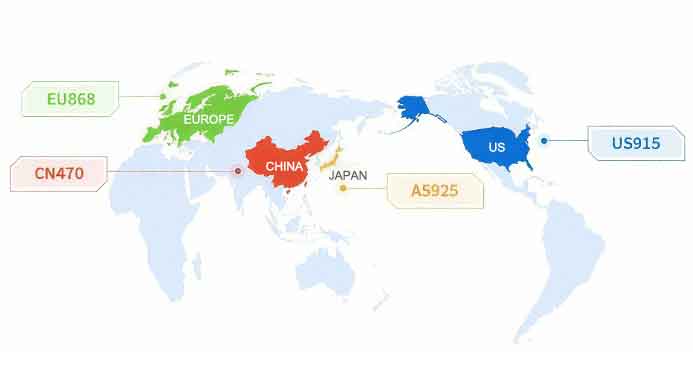
LoRaWAN operates on different sub-GHz frequency bands depending on regional regulations and network requirements. These operating frequencies allow LoRa devices to achieve long-range wireless communication with low power consumption, making them widely used in IoT applications.
Common LoRaWAN frequency bands include:
433 MHz:Commonly used in parts of Asia and regions where this band is permitted, providing long-range communication with good penetration capability.
868 MHz:Widely adopted in Europe for LoRaWAN networks and commonly used in smart city, industrial monitoring, and IoT deployments.
915 MHz:Mainly used in North America, Australia, and some other regions, supporting reliable long-range communication.
Other LoRa frequency bands include 169 MHz, 315 MHz, and AS923 depending on regional requirements.
When selecting a LoRa antenna, the antenna frequency must match the operating frequency of the LoRa module or gateway to ensure efficient signal transmission.
When selecting the best LoRa antenna and LoRaWAN applications, you should prioritize electrical parameters, installation environment, and physical constraints, rather than external appearance.
Common LoRa antenna types include spring antennas, PCB antennas, FPC antennas, Ipex SMA antennas, and fiberglass antennas. Different antennas can be chosen based on the LoRa module’s power output and operating frequency.
LoRa antennas typically support a specific range of frequency bands. Using them outside this range will result in a certain degree of performance degradation.
For example, a 915 MHz antenna should be used in the 915 MHz band. Using a 915 MHz antenna in the 868 MHz band will yield poor results. However, if the antenna is designed to cover both 915 MHz and 868 MHz bands, it will perform well at both frequencies.
Therefore, devices should operate within the frequency bands supported by their antennas to achieve optimal transmission performance.
In communication systems, antenna gain directly impacts the ability to radiate or receive wireless signals. Under identical conditions, higher gain enables wireless signals to propagate over greater distances.
Consequently, selecting a high-gain antenna is an effective strategy for extending the communication range of wireless modules.
Finally, pay attention to the antenna feed cable assembly, SMA-to-N-type adapter cables, and the length of cables used with magnetic-mount antennas. Particularly with longer cables, the attenuation effect of the conductors on the antenna must be fully considered for signal integrity.
Choosing the best LoRa antenna requires careful consideration of key factors such as operating frequency, gain, antenna type, and installation environment. The right antenna design helps improve communication range, signal stability, and overall LoRaWAN system performance.
As a professional wireless antenna manufacturer, Airplux provides LoRa antenna solutions covering multiple frequency bands, including 169 MHz, 315 MHz, 433 MHz, 868 MHz, and 915 MHz. With different antenna designs and gain options, Airplux supports a wide range of IoT applications, from LoRaWAN gateways and smart monitoring systems to industrial wireless networks.
For customized LoRa antenna requirements, contact Airplux to find the right antenna solution for your project.
Airplux Technologies is a professional antenna manufacturer specializing in the design, development, and production of wireless antenna solutions.
With extensive experience in RF antenna technology, Airplux provides reliable antenna products for LoRa, RFID, WiFi, IoT, and other wireless communication applications. Our LoRa antenna solutions cover multiple frequency bands, including 433 MHz, 868 MHz, and 915 MHz, with different designs and gain options to meet various deployment requirements.
From standard antenna products to customized solutions, Airplux supports system integrators, enterprises, and manufacturers with stable performance, flexible production capabilities, and reliable technical support.
Ready to Find the Right Antenna Solution?
Airplux provides customized antenna solutions for different applications and project requirements. Contact our antenna experts to discuss your next project.
