
RFID Asset Tracking: Why Companies Lose Visibility of Critical Assets
RFID Asset Tracking:
Why Companies Lose Visibility of Critical Assets
Most organizations don’t lose assets because they disappear. They lose them because they lose visibility.
RFID asset tracking helps close those visibility gaps with real-time, traceable asset data.
introduction
A maintenance technician spends twenty minutes looking for a calibration tool before a scheduled inspection. A warehouse team discovers missing equipment only during a year-end audit. A hospital purchases another infusion pump because nobody can confirm where the existing one is.
In most cases, these assets were never truly lost. The problem isn’t ownership. It’s visibility. Organizations often know what they own, but struggle to know where those assets are, who is using them, and whether they’re available when needed.
As operations grow, spreadsheets, manual logs, and barcode scans become harder to maintain. RFID asset tracking changes that by turning asset visibility from a periodic exercise into a continuous process. But the technology only works if the data capture layer works — and that layer starts with the antenna.
The challenge is not asset ownership. The challenge is asset visibility.
The Hidden Cost of Invisible Assets
- Most organizations don’t lose assets because they disappear. They lose them because they lose visibility.
When equipment, containers, tools, or inventory can no longer be located quickly, the consequences go far beyond replacement cost. The asset may still exist somewhere in the operation, but without reliable visibility, teams end up making decisions based on assumptions rather than facts.
The hidden costs often appear in four areas:
| Visibility Gap | Operational Impact |
|---|---|
| Missing Equipment | Time spent searching for assets instead of using them. |
| Duplicate Purchases | Organizations buy replacements for assets they already own but cannot locate. |
| Delayed Maintenance | Equipment cannot be serviced on schedule when its location or status is unknown. |
| Audit Inefficiencies | Teams spend hours reconciling records and physically verifying assets. |
Over time, these costs accumulate through lost productivity, unnecessary spending, and operational delays. In many cases, the asset was never lost at all—it simply became invisible to the system.
This is where RFID asset tracking changes the equation. Visibility improves when asset movements become events instead of assumptions. But those events only exist when tags are successfully read. And every successful read starts at the antenna.
What Makes Asset Tracking So Difficult?
Tracking an asset sounds simple until that asset starts moving.
A laptop is checked out by another department. A tool is taken to a maintenance job. A returnable container leaves one facility and returns weeks later. The challenge is not that assets disappear—it is that information often fails to keep up with their movement.
As organizations grow, visibility gaps tend to appear in four areas.
Assets Move
Equipment, tools, containers, and inventory rarely stay in one place. Every transfer, relocation, or shipment creates another opportunity for records to fall behind reality. An asset can still be on-site but become difficult to find because its location was never updated.
Assets Change Hands
Assets frequently move between departments, shifts, contractors, and facilities. Without a reliable way to capture those handoffs, ownership becomes unclear and accountability becomes harder to maintain.
Assets Cross Locations
Many assets travel through warehouses, production areas, service vehicles, distribution centers, and customer sites during their lifecycle. The more locations involved, the harder it becomes to maintain a single, accurate view of where an asset is.

Manual Tracking Can't Keep Up
Spreadsheets, paper logs, and barcode scans can work for small operations. But as asset volumes increase and movements become more frequent, manual updates become harder to maintain. Missed scans and delayed records gradually create gaps between physical assets and digital records.
Reliable asset tracking depends on keeping information synchronized with real-world movement. The challenge is not simply knowing where an asset was—it is knowing where it is now.
RFID Changes Asset Tracking from Periodic to Continuous
Traditional asset tracking provides snapshots. RFID creates a continuous stream of asset visibility.
Traditional asset tracking relies on occasional events—a quarterly inventory count, a barcode scan at check-in, or a manual update during a shift change. Between those events, the system often knows very little. An asset can move multiple times while the record still shows its previous location.
RFID changes the trigger. Instead of waiting for someone to scan or update a record, tagged assets can be identified automatically as they pass through a read point. Each successful read becomes a new visibility event, helping keep asset records aligned with real-world movement.
This is the core promise of RFID asset tracking: turning visibility from a periodic activity into a more continuous process. But continuous visibility depends on consistent data capture. If a movement is not recorded, the system cannot reflect what actually happened.
That is why the read point matters. Tags, readers, software, and antennas all play a role, but visibility begins with the successful capture of an event. Without that event, even the most advanced tracking system is working with incomplete information.
Traditional Asset Tracking
Large visibility gaps between events
RFID Asset Tracking
Continuous Visibility
What Reliable Asset Visibility Actually Looks Like
Reliable asset visibility is not simply knowing where an asset is today. It means knowing where it was, where it is now, and how it got there. More importantly, it means trusting that information without stopping operations to verify it.
When visibility works, every movement creates a traceable record. Assets are located quickly, handoffs are documented automatically, and historical activity is available when questions arise.
Asset Lifecycle Visibility:
Received → Stored → Assigned → Moved → Maintained → Returned
Every step creates a visibility event.
Visibility Is More Than Location
A location alone does not explain what happened to an asset. Reliable visibility also includes movement history, ownership changes, and operational status.
Knowing a tool is in Building A is useful. Knowing when it arrived, who used it last, and whether it is due for maintenance is far more valuable. That’s the difference between tracking assets and understanding them.Reliable visibility typically comes down to four dimensions:
| Dimension | What It Answers | What Happens Without It |
|---|---|---|
| Location | Where is the asset right now? | Lost time searching, incorrect records |
| History | How did it get here? | Audit gaps, limited traceability |
| Status | Is it available, in use, or under maintenance? | Unplanned downtime, operational delays |
| Trust | Can people rely on the information? | Shadow spreadsheets, manual verification |
All four depend on the same foundation: reliable data capture.
If an antenna misses a tag, location records drift, movement history becomes incomplete, status information goes stale, and confidence in the system begins to erode. Software can process data, but it cannot recover an event that was never captured.
That is the promise of RFID asset tracking—continuous, trustworthy visibility. But continuous visibility is only possible when every read point performs reliably. Every visibility event begins with a successful read.
The Infrastructure Behind Reliable Asset Visibility
Reliable asset visibility doesn’t come from a dashboard alone.
Behind every location update, status change, and audit trail is a chain of technologies working together to capture, process, and share asset data. If any part of that chain fails, visibility becomes incomplete.
A typical RFID asset tracking system consists of four layers:
1. RFID Tags
Tags give each asset a unique identity. They answer the question: Which asset is this?
But tags aren’t one-size-fits-all. A standard UHF label on a metal tool can detune and lose read range. Liquid absorbs UHF energy, while freezers and high-temperature environments often require specialized tag designs. Choosing the right tag is the first step toward reliable asset visibility.
2. RFID Antennas and Readers
Antennas create the read zone. Readers decode the captured signals. Together, they determine whether an asset movement becomes a visibility event—or disappears without a trace.
This is where visibility begins. The reader is only as good as the signal it receives. If the antenna misses the tag, the reader has nothing to decode.
Tags identify. Readers decode. Antennas capture. If the antenna misses, there is no event to process.
3. RFID Software
Software collects read events, applies business rules, and turns raw RFID data into meaningful information. It filters duplicate reads, generates movement records, and triggers alerts when exceptions occur.
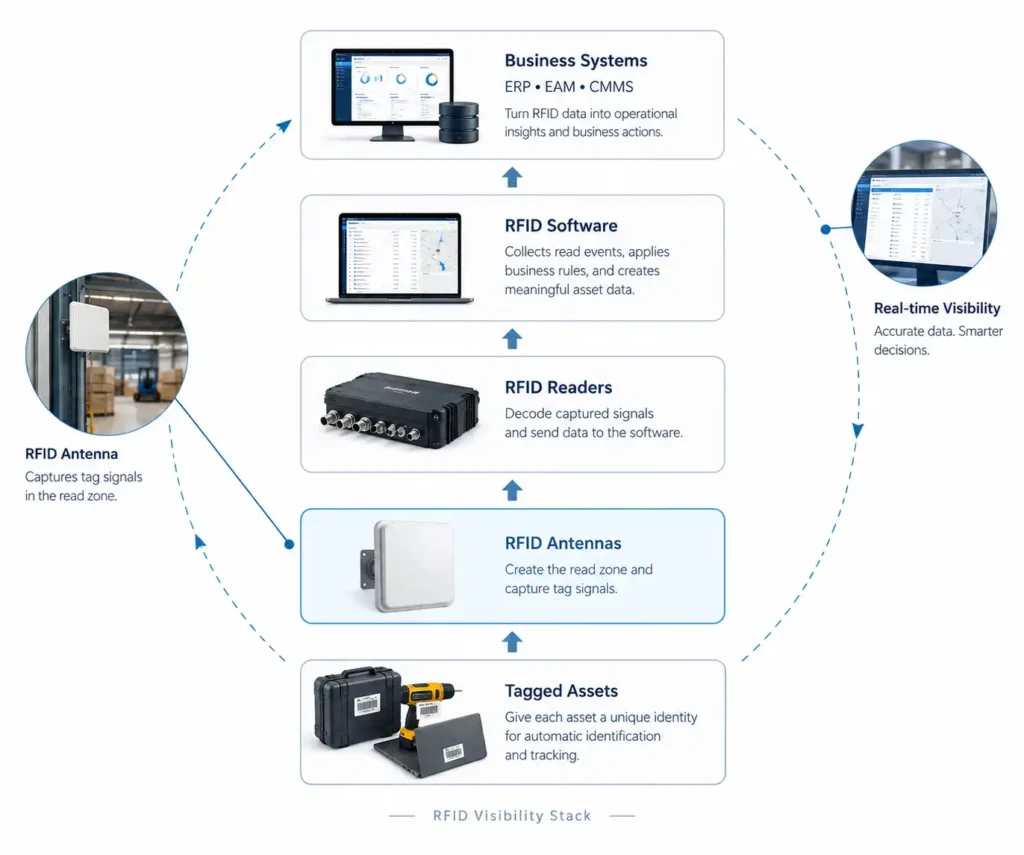
But software can only work with the data it receives. If the capture layer misses a movement, the software is working with incomplete information. Bad input leads to bad output.
4. Business Systems
ERP, EAM, CMMS, and other enterprise platforms use RFID data to support operations, maintenance, inventory management, and reporting. This is where RFID asset management becomes operational—assets are assigned, maintained, audited, and retired based on live data.
Most discussions about asset tracking focus on software because that is where visibility appears. But visibility starts much lower in the stack.
If a tag is never captured, the reader has nothing to process, the software has nothing to analyze, and the business system has nothing to update.
Reliable asset visibility is built from the ground up. Every accurate record begins with a successful read.
The dashboard may be where visibility appears, but the read point is where visibility begins.
Why Most Projects Fail—and Where Antennas Fit In
Here’s what that looks like in practice.
Most RFID asset tracking projects don’t fail because the software is wrong. They fail because the read zone doesn’t work the way it did in the demo.
The demo happens in an open room. Tags face the same direction. No metal racks. No forklifts. No liquid containers. Then you go live, and the same antenna that read 100% in the demo struggles to break 70%.
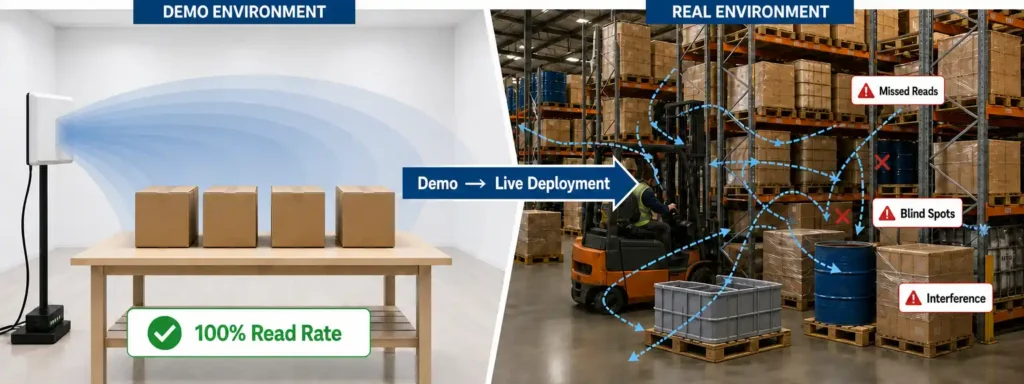
- What works in a controlled demo environment may behave very differently in a live deployment.
Wrong antenna type: A far-field antenna on a metal tool cabinet reads the cabinet next door. You think the tool is in Cabinet A. It’s in Cabinet B. This is common in RFID tool tracking. Near-field antennas solve it by reading only what’s directly above them.
Wrong polarization: Linear antennas give you more gain in one direction. That works when tags always face the same way. On tools that get dropped and flipped, circular polarization keeps the read rate steadier.
Wrong mounting height and angle: A portal antenna at the wrong height creates a blind spot at the bottom of the cart. You miss the lowest layer of assets. No software setting fixes that.
Metal and liquid. Metal reflects UHF energy. Liquid absorbs it. Both change the read zone. You can’t tune your way out of physics. You change the antenna, the tag, or both.
Multi-antenna interference and cable loss: Two antennas covering the same area can read the same tag twice, or read tags from the next zone. You get ghost assets and false alerts. Long cable runs and high power settings don’t always help. High power can bleed into the next aisle.
So where do antennas fit in?
They are the first decision, not the last. Start with the read zone: what needs to be read, how far away, how fast, and in what environment. Then choose near-field or far-field, circular or linear, and the gain and beam that match the zone.
Tags identify. Readers decode. Antennas capture. If the antenna misses, there’s no event. If there’s no event, there’s no visibility. The software can’t fix a missed read.
Most of these failures are preventable. You just have to test the read zone before go-live, not after. The next section walks through a deployment checklist that catches them early.
Designing Around Real Workflows: A Deployment Checklist
Successful RFID deployments rarely start with hardware specifications. They start with understanding how assets move through the operation.
Before choosing tags, readers, or antennas, it helps to map the workflow first.The goal is not to create the largest read zone. The goal is to capture the right event at the right place. That’s what turns RFID asset tracking from a hardware install into a reliable visibility system.
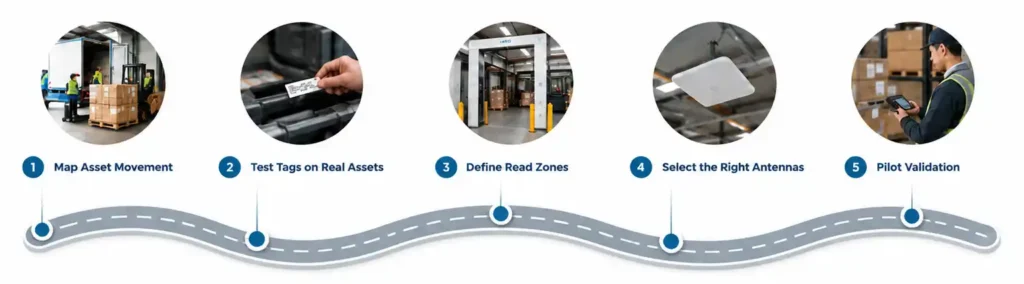
A practical deployment checklist often looks like this:
Map Asset Movement → Test Tags on Real Assets → Define Read Zones → Select the Right Antennas → Validate with a Pilot Deployment
· Map Asset Movement
Start by understanding how assets actually move through the organization. Where are assets received? Where are they stored? Who uses them? When do they leave one area and enter another?
RFID works best when visibility events align with real operational workflows, not assumptions about how work should happen. A well-mapped workflow tells you where asset visibility needs to happen, and where a read event is actually useful.
· Test Tags on Real Assets
A tag that performs well on a test bench may behave very differently on a metal tool, medical device, liquid container, or electronic equipment.
Before selecting infrastructure, test tags on the actual assets that will be tracked. This helps identify potential read challenges early and avoids surprises during deployment. If you’re tracking tools, this is the point where RFID tool tracking either works or falls apart.
· Define Read Zones
Once the workflow is clear, determine where visibility events should occur. Doorways, tool rooms, storage areas, maintenance stations, and loading docks are common read points. Each location requires a read zone designed for the specific movement being captured.
The objective is not maximum coverage—it’s reliable coverage. A zone that reads everything including the neighbors’ assets isn’t a good zone. It’s a source of ghost data.
· Select the Right Antennas
Only after the read zone is defined should antenna selection begin.
Near-field and far-field antennas solve different problems. Circular and linear polarization perform differently depending on tag orientation. Gain and beamwidth influence how energy is distributed across the read zone.
The best RFID antenna for asset tracking is not the one with the longest range. It’s the one that matches the workflow and environment. A near-field antenna for a metal cabinet. A narrow-beam circular antenna for a doorway. A wide-beam antenna for open shelving. Selection follows the zone, not the other way around.
· Validate with a Pilot Deployment
Before rolling out across the entire operation, validate the design in a real-world environment. Test asset movement, read accuracy, environmental conditions, and user workflows. Small adjustments to antenna placement, mounting height, or tag positioning can significantly improve read rate optimization before full deployment.
The most successful RFID projects are rarely the most complex. They are the ones designed around how work actually happens. When workflows, read zones, tags, and antennas are planned together, reliable real-time asset tracking becomes much easier to achieve — and much easier to trust.
The Future of RFID Asset Tracking
RFID asset tracking is moving beyond simple identification. Organizations increasingly expect real-time visibility, automated updates, and data that flows directly into business systems.
Sensor-enabled tags, predictive maintenance, and deeper integration with ERP and asset management platforms are making RFID more valuable than ever. But as systems become smarter, their dependence on reliable data also increases.
The technology will continue to evolve. The principle remains the same.
No matter how advanced the software becomes, visibility still starts with a successful read.
For RFID asset tracking, the future isn’t just about collecting more data—it’s about capturing the right data at the right moment. And that still begins with the antenna.
About Airplux RFID Antenna Solutions
Airplux Technologies specializes in RFID antenna design and manufacturing, providing reliable RFID antenna solutions for various identification and tracking applications.
With professional antenna design capabilities and manufacturing experience, Airplux offers a wide range of RFID antennas, including UHF RFID antennas, near-field RFID antennas, ceramic RFID antennas, narrow beam antennas, and integrated RFID antenna solutions.
Our RFID antennas are designed to deliver stable signal performance, accurate tag reading, and reliable operation in different RFID environments. By supporting both standard products and customized antenna solutions, Airplux helps system integrators, enterprises, and manufacturers develop efficient RFID systems for inventory management, access control, logistics tracking, asset management, and other applications.
Explore RFID Antenna Solutions
Ready to Find the Right Antenna Solution?
Airplux provides customized antenna solutions for different applications and project requirements. Contact our antenna experts to discuss your next project.