
RFID in Automotive Manufacturing: Tracking Every Part From Assembly to Delivery
RFID in Automotive Manufacturing
——Tracking Every Part From Assembly to Delivery
Table of Contents
introduction
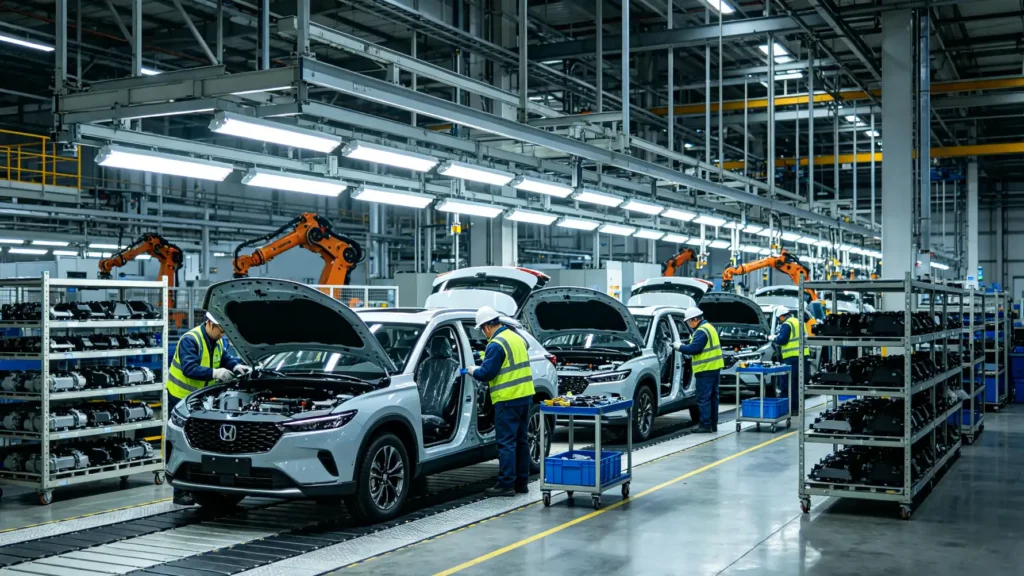
If you manage an automotive production line, you already know the challenges: barcodes get missed, work-in-process (WIP) visibility disappears between stations, and when a recall occurs, tracing affected vehicles can take far longer than anyone would like.
These aren’t isolated issues. They’re the result of production environments becoming more complex while many tracking methods remain largely unchanged. Modern automotive plants run mixed-model lines, handle thousands of components, and rely on increasingly interconnected supply chains.
This is where RFID comes in. By eliminating line-of-sight requirements and enabling automatic, real-time data capture, RFID helps manufacturers improve visibility across the production process. In this article, we’ll look at how RFID works in automotive manufacturing, where it delivers the greatest value, and what challenges should be considered before deployment.
Why Automotive Manufacturing Is Difficult to Track
Automotive manufacturing is built around precision, but maintaining visibility across the entire production process is far from simple. A modern vehicle can contain thousands of components sourced from multiple suppliers, all moving through different production stages before final assembly. Every part needs to arrive at the right place, at the right time, and be installed on the correct vehicle.
At the same time, most automotive plants no longer build a single model on a dedicated line. Different vehicle variants, optional features, and customer-specific configurations often share the same production environment. This mixed-model production increases flexibility, but it also multiplies the number of part combinations that must be verified at each station. Manual scanning errors and barcode limitations become harder to absorb as line speed increases.
Work-in-process (WIP) visibility adds another layer of complexity. Components and partially assembled vehicles continuously move between workstations, inspection areas, and buffer zones. Without accurate real-time data, manufacturers can struggle to locate parts, identify bottlenecks, or understand the current status of production. A missing scan at one station can leave a vehicle invisible to the system for hours.
Traceability requirements are also increasing. When a quality issue occurs, manufacturers need to quickly determine which vehicles are affected, which components were installed, and where those components originated. The longer that process takes, the greater the operational and financial impact. IATF 16949 requires traceability to the level needed to identify nonconforming or suspect product, but that level is difficult to reach when production data is incomplete.
These challenges are difficult to manage with paper records or line-of-sight scanning alone. As production volumes grow and supply chains become more connected, manufacturers need a faster, more reliable way to capture and track data throughout the entire production process. That is where RFID in automotive manufacturing starts to make sense.
What Is RFID in Automotive Manufacturing?
RFID (Radio Frequency Identification) uses radio waves to automatically identify and track physical objects. RFID in automotive manufacturing is commonly used to track parts, assemblies, tools, and vehicles as they move through different stages of production. The tag itself does not manage the object; it provides the identity data that production systems use to manage it.
Unlike barcode systems, RFID does not require direct line of sight between the tag and the reader. Components can be identified automatically as they pass through production stations, storage areas, or inspection checkpoints, without manual scanning. In practice, read performance depends on tag selection, reader placement, and the surrounding environment. Metal surfaces and high-temperature processes are two conditions that shape how RFID is deployed in automotive plants.
A typical automotive RFID system consists of tags attached to parts or carriers, readers, antennas, and backend software. Together, these components create a data flow between the physical production line and manufacturing systems such as MES, WMS, or ERP. UHF RFID is the most widely used technology in automotive manufacturing because it supports longer read ranges and can identify multiple tagged items simultaneously. HF and LF RFID are still used in some short-range or specialized applications, but UHF dominates most production and logistics processes.
By providing automatic identification and continuous visibility, RFID helps manufacturers improve inventory accuracy, monitor work-in-process (WIP), verify assembly operations, and maintain end-to-end traceability. How that data moves from a tag on the line to a live MES record is where the practical details matter.
Parts / Tools / Vehicles
RF Signal Coverage
Data Collection
Production Systems
Tracking & Traceability
How RFID Works on an Automotive Production Line
A tagged part, carrier, or vehicle body enters the read zone of an RFID system. Its identity is captured automatically and forwarded to manufacturing systems. No line of sight is required, and no operator needs to stop production to perform a scan.
From middleware, the ID is passed to a PLC or directly to the MES. The MES checks it against the production order for that station. If the identity matches the expected part or vehicle, the system releases the next operation. If it doesn’t, the station can trigger an alert or block the process.
At a welding station, a confirmed body ID can automatically call up the correct welding program for that specific model. During final assembly, a verified part ID can unlock a torque tool with the appropriate parameters. In sequencing and buffer areas, a missed read can trigger a line-side replenishment request before a workstation runs short of material. The tag itself doesn’t make these decisions. It provides the identity. The MES and PLC determine what happens next.
Deployment depends on the plant environment. Metal vehicle bodies reflect radio signals, which is why tags mounted on steel often require anti-metal designs. Paint shop ovens may expose tags to temperatures above 200°C, requiring specialized high-temperature housings. Read accuracy must remain high even when production lines run continuously. In most automotive deployments, reliable reads matter more than maximum read range. A missed read can disrupt an entire workflow.
One RFID read can trigger multiple actions:
BOM validation → Error-proofing → Assembly record → WIP update → Vehicle traceability
Each action depends on the same read being captured correctly. One read event can update production records, verify assembly operations, and add to the vehicle’s traceability history.
The pattern repeats across the plant: identify, verify, respond, record. Hardware changes from station to station, but the sequence holds. The next section looks at where this process delivers the most value.
RFID Applications Across the Automotive Production Line
RFID creates value throughout an automotive plant, from receiving materials to tracking finished vehicles. Deployments vary by plant, but most projects target the same outcomes: real-time visibility, fewer manual steps, and accurate production records. The sequence below follows the production flow.
Receiving and Warehousing
Incoming parts arrive from dozens or hundreds of suppliers. RFID tags applied at the supplier site allow automated receiving at the dock door. As pallets or containers pass a fixed reader portal, the system logs the delivery against the advance shipping notice and updates inventory in the WMS. For returnable steel pallets, on-metal tags survive repeated trips and reduce manual reconciliation.
Parts Tracking
Engines, transmissions, seats, and battery packs each carry a unique digital identity that links to the part number, supplier batch, and intended vehicle. When a part reaches a workstation, the reader captures its ID without line-of-sight scanning. The MES compares it to the production order for that station. If the part doesn’t belong on that vehicle, the station blocks or alarms.
WIP Tracking
A vehicle body moves through welding, paint, and assembly over hours or days, passing through buffer zones, inspection areas, and rework loops. RFID readers at entry and exit points update the WIP status in real time: awaiting production, on the line, in buffer, in rework, or completed. With accurate work-in-process tracking, bottlenecks become visible before they stop the line.
Assembly Verification
On a mixed-model line, installing the wrong component leads to costly rework. At engine, transmission, seat, or battery pack stations, a fixed reader verifies that the arriving component matches the VIN and BOM for that vehicle. If the part is wrong — wrong model, wrong batch, or non-conforming — the system triggers a workstation alert or PLC interlock. The shift is from “operator checks and confirms” to “system verifies and records.
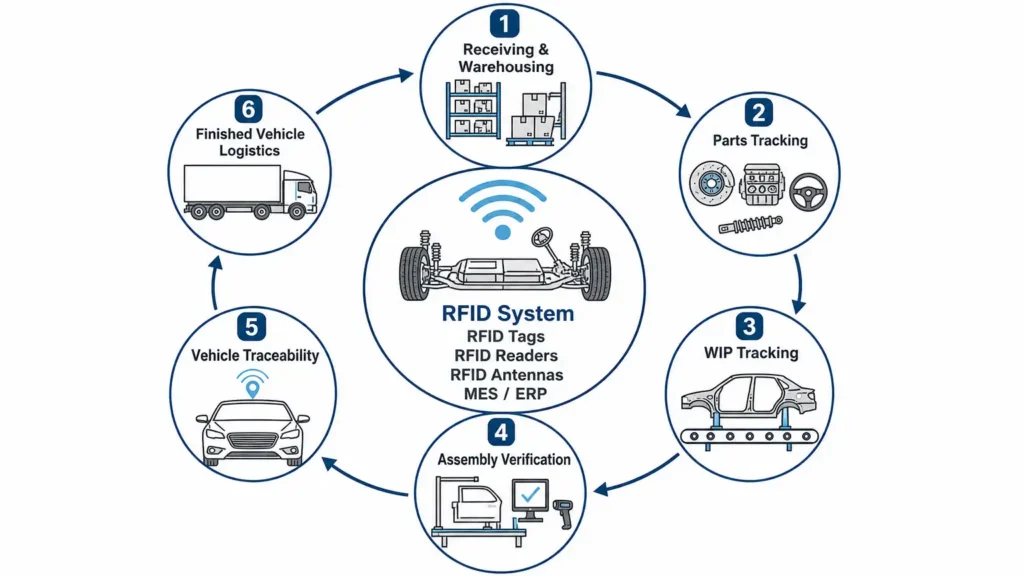
Vehicle Traceability
Between 35 and 60 RFID tags can be embedded in a single vehicle across taillights, airbags, seats, and other critical components. As each tagged part is installed, the reader captures the as-built configuration: which serialized component went into which vehicle. That record supports targeted recalls, warranty analysis, and root-cause investigation.
Finished Vehicle Logistics
Once a vehicle rolls off the line, its VIN is associated with an RFID tag. In the yard, fixed or handheld readers track vehicle location, movement, and shipping status. Real-time location intelligence reduces manual yard checks and prevents delays when vehicles are misplaced. At Volkswagen Wolfsburg, RFID automates fueling based on vehicle type.
Each stage adds a layer to the same data trail: from supplier tag to dock door read, from line-side verification to as-built record, from WIP status to yard location. The sections that follow examine how RFID compares to barcode, where it works best, and what deployment actually requires.
RFID vs Barcode in Automotive Manufacturing
Barcode systems still play an important role in automotive manufacturing, but modern production environments are exposing their limits. Mixed-model assembly lines, high production volumes, and tighter traceability requirements demand faster and more automated data collection. That is where RFID starts to offer advantages.
The question is not whether barcode works—it does. The question is whether it can keep up with the speed and complexity of a modern automotive plant.
| Feature | Barcode | RFID |
|---|---|---|
| Line of Sight | Required | Not Required |
| Reading Method | One item at a time | Multiple tags at once |
| Automation Level | Manual scanning | Automatic identification |
| Read Speed | Seconds per item | Milliseconds per tag |
| Data Capacity | Fixed ID only | Read/write, larger memory |
| Traceability | Basic, point-in-time | End-to-end, as-built record |
| Durability | Degrades with heat, dust, and metal spatter | Survives with anti-metal or high-temperature housing |
| Unit Cost | Under $0.01 per label | $0.05–$0.30 for passive UHF inlays; $0.10–$1.00+ for industrial hard tags |
| Upfront System Cost | Lower | Higher, including readers, antennas, and software integration |
| Best Fit | Simple, stationary, low-risk identification | WIP, assembly verification, traceability, logistics |
Where Barcode Still Makes Sense
Barcode remains a practical solution for low-cost identification and simple inventory management. It is inexpensive, widely adopted, and easy to deploy. For many warehouse and logistics processes—especially where a part is stationary and an operator is already present—barcode continues to perform well.
Many automotive manufacturers still rely on barcode labels for inventory control, packaging identification, and supporting processes where full automation is not required. Nothing in an RFID deployment requires replacing those applications.
Where RFID Creates More Value
RFID becomes more valuable when manual scanning starts slowing the process down. On automotive production lines, parts move quickly, multiple components need to be identified at the same time, and traceability requirements continue to increase. In these situations, automatic identification often delivers greater operational value than the lower upfront cost of barcode systems.
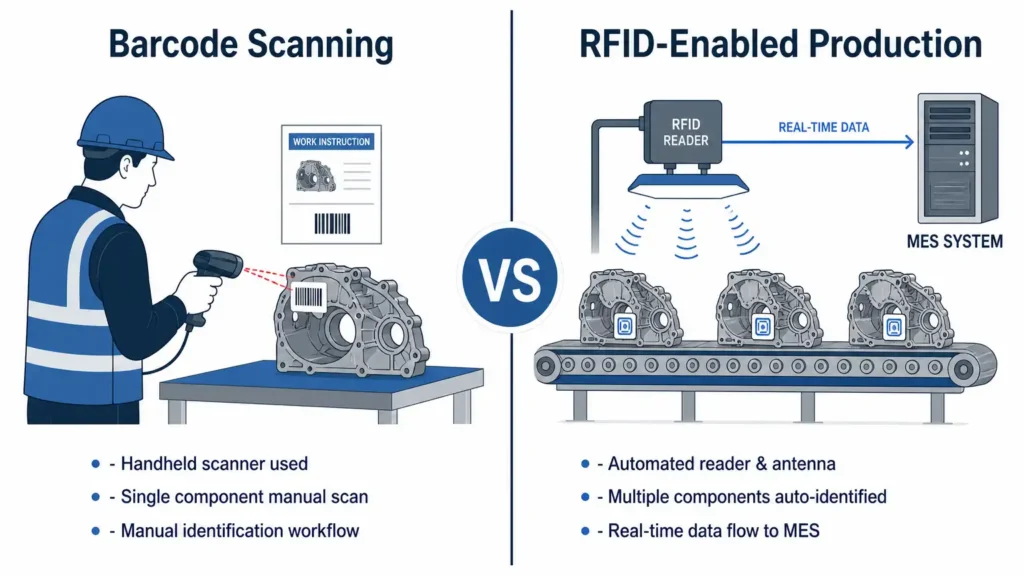
The difference becomes particularly clear in applications such as work-in-process (WIP) tracking, assembly verification, and vehicle traceability. Instead of requiring operators to scan individual labels, RFID can identify parts automatically as they move through production. Manufacturing systems can then verify that the correct component reaches the correct workstation, update production records in real time, and maintain visibility across the entire production line.
In automotive manufacturing, the most important advantage is often not read range—it is the ability to capture data without interrupting production.
One Is Not Replacing the Other
In practice, most automotive manufacturers use both technologies. RFID is typically deployed in areas where automation, traceability, and real-time visibility are critical. Barcode remains a cost-effective solution for simple identification tasks and supporting processes.
The choice is rarely RFID or barcode. It is usually RFID and barcode working together.
If a part needs to be identified automatically, at production speed, in a harsh environment, and linked to a digital production record, RFID is often the better fit.If the part is stationary, low-risk, and already covered by an effective barcode process, there may be little reason to change.
What matters is fit. Not which technology is better in general, but which one matches the automation, traceability, and reliability required for a specific process.
Why RFID Works So Well in Automotive Manufacturing
Automotive manufacturing combines four conditions that make RFID particularly effective: high production volume, complex product variants, strict traceability requirements, and demanding operating environments.
A modern vehicle passes through hundreds of production steps, while thousands of components move through the plant every day. Production systems need to know exactly which part is present, where it is located, and what operation should happen next. RFID provides that visibility without requiring manual scans or interrupting production flow.Passive UHF tags read in milliseconds, and a single reader can capture dozens at once.
The technology is especially valuable on mixed-model assembly lines, where different vehicle configurations are built on the same line. RFID helps verify that the correct component reaches the correct workstation and supports real-time production tracking throughout the process.
Traceability is another key factor. Automotive manufacturers must maintain accurate production records for quality investigations, warranty analysis, and recalls. RFID creates a digital link between components, production events, and finished vehicles.A barcode record is created only when someone scans. An RFID record is created as the part moves.
Tag designs for metal-rich and high-temperature environments already exist. At Mercedes-Benz Rastatt, UHF readers handle roughly 350,000 readings per day in a metal-dense paint shop, with peak accuracy above 99.98%. High volume, high variety, strict traceability, harsh environment — few industries combine all four. Automotive does.
Challenges of RFID Deployment
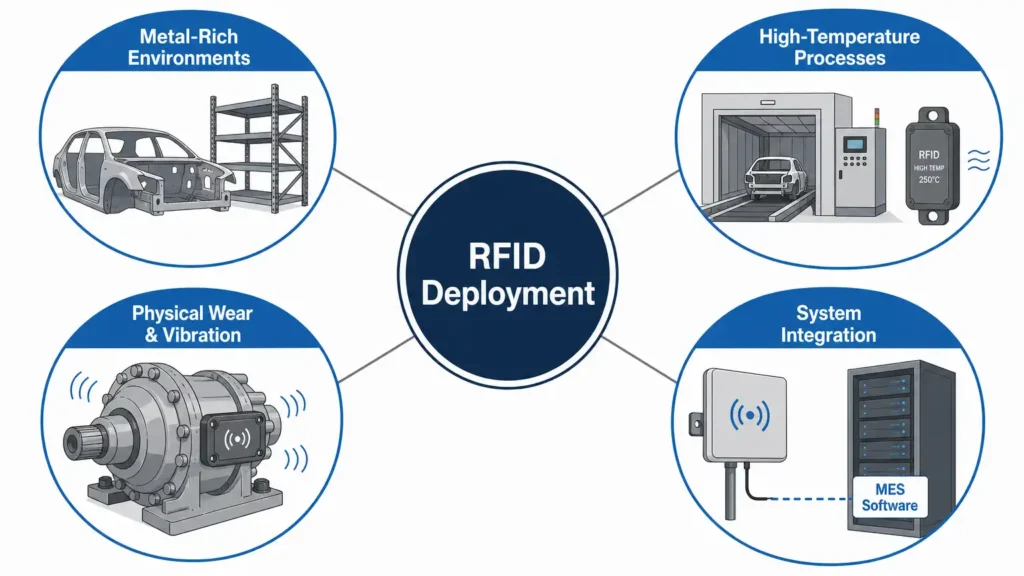
RFID delivers real value in automotive manufacturing, but successful deployment requires more than simply attaching tags to parts. The same conditions that make RFID effective—high production volumes, mixed-model assembly, and demanding production environments—also create implementation challenges.
Metal is the first challenge. Vehicle bodies, steel racks, and returnable containers can affect radio performance and reduce read reliability. To address this, automotive projects often use anti-metal tags and carefully planned antenna placement to ensure consistent reads throughout the production process.
Temperature is the second. Paint shop ovens, welding areas, and other manufacturing processes expose tags to heat and harsh conditions that standard labels cannot withstand. In these environments, specialized high-temperature RFID tags are often required to maintain reliable performance.
Physical wear is the third. Tags mounted on pallets, carriers, and returnable containers experience repeated impacts, vibration, and handling. In many automotive applications, mechanical damage is a more common cause of tag failure than electronic failure, making durability just as important as read performance.
System integration is the fourth. Capturing tag data is only part of the process. The real value comes when RFID information connects with MES, ERP, WMS, or PLC systems and becomes part of the production workflow. Reliable reads, accurate data exchange, and well-designed business logic are often more important than the tag itself.
None of these challenges are barriers to deployment. They are engineering considerations that influence system design. In most automotive projects, success depends as much on planning and implementation as on the RFID hardware itself.
The Bottom Line
Automotive manufacturing is ultimately a visibility problem. Parts move between suppliers, warehouses, production stations, inspection areas, and finished vehicle yards. The larger and more complex the operation becomes, the harder it is to know exactly where everything is, what has been completed, and what should happen next.
RFID in automotive manufacturing does not replace production systems, and it does not solve problems by itself. What it provides is reliable identification and real-time data. When that data connects to MES, ERP, and production workflows, manufacturers gain better inventory accuracy, stronger traceability, and greater control over daily operations.
Not every process needs RFID. Barcode still has a place in many facilities. But where speed, automation, and traceability matter, RFID has become one of the most practical tools available on the plant floor.
The challenges are real—metal, heat, physical wear, and system integration. Yet these are engineering problems with proven solutions. Most successful deployments start with a single process, validate read performance and system integration, and then expand across the operation.
As automotive production becomes more connected and data-driven, the ability to identify, verify, and track assets automatically will only become more important. For manufacturers taking that first step, the focus is rarely the technology itself—it is choosing the right application and deploying it correctly.
About Airplux Antenna Solutions
Airplux Technologies is a specialized antenna manufacturer integrating antenna design, research and development, production, and sales. We provide reliable antenna solutions covering RFID antennas, WiFi antennas, DAS antennas, IoT antennas, base station antennas, and customized antenna products from 350MHz to 6GHz.
With professional antenna design capabilities and flexible manufacturing experience, Airplux supports customers with both standard antenna products and customized solutions for different project requirements. Our antennas are widely used in various wireless communication and identification systems worldwide, serving system integrators, enterprises, and manufacturers with stable performance and reliable quality.
Please contact us for more detailed info or any inquiry: info@airpluxtec.com